
A supplier tells you its cookie tins are “food grade.” That sounds reassuring, but it doesn’t answer most of the important questions.
What is the inside of the tin coated with? Do the cookies touch it? Is the supporting report on butter biscuits, chocolate-coated cookies or just on some other food type? Is the product intended for the EU, Great Britain, the US or for several markets at the same time?
A folder of certificates could still be the incorrect compliance file.
When we view a project of cookie tin , we do not start by counting how many certificates the buyer or material supplier already has . We start with the pack itself, what touches the cookies, how long the contact time is and where the finished product will be sold.
The answers will guide the buyer as to which food contact documents he needs to pursue.
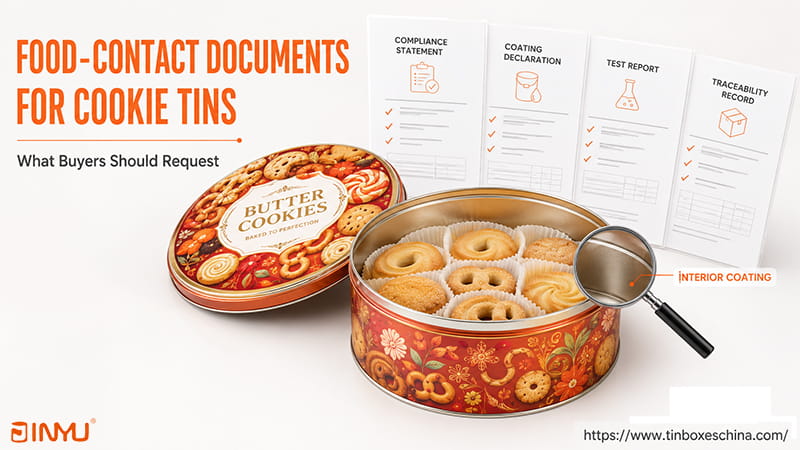
If you only need the five-minute version, focus on these five things:
Further testing may be required dependent on the market and packaging structure. But these five things are a much better place to begin than a generic “food-grade certificate.”
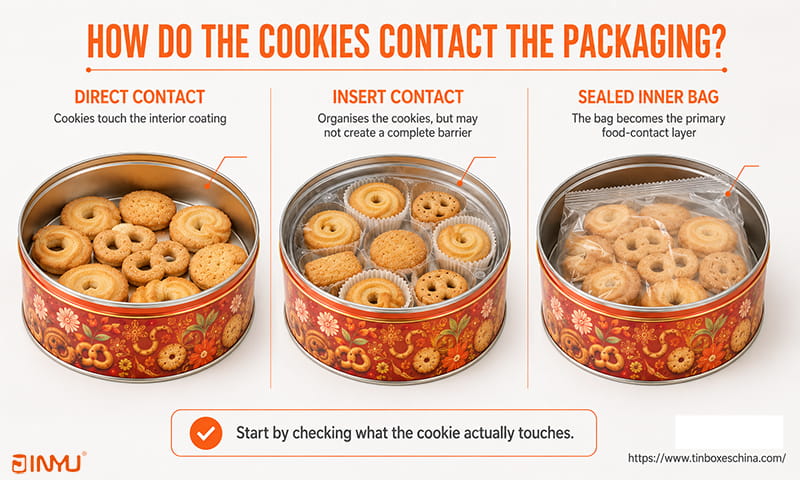
The easiest way to define the compliance scope is to follow the cookie through the finished pack.
A cookie can be:
These arrangements offer different avenues of contact.
Normally, the main food-contact layer is the sealed inner bag. But that doesn't automatically make the tin obsolete. The packaging must still be fit for its intended purpose and buyers should consider whether contact with the tin is reasonably foreseeable once the bag is opened.
This becomes important when the packaging is advertized as a reusable cookie tin. And the consumer can then put unpackaged biscuits straight in.
The cookie recipe is also part of the evaluation. A dry cracker, a high fat butter cookie and a moist filled biscuit do not behave the same. Also the time and temperature of storage matter.
Studies on metal can coatings have indicated that migration may be influenced by temperature and food composition. For example, a study on factors influencing BPA migration from cans found that processing conditions and food constituents affected the results .
This was heat-processed canned food, not an ambient cookie tin. Buyers are under no obligation to simply duplicate those extreme test conditions. The useful lesson is a simpler one: supporting evidence should match the intended food and use conditions rather than vaguely referring to “food contact.”
The scope of the document is more important than its name. A Declaration of Compliance, compliance statement or laboratory report is only of any value if it can be linked to the actual product being ordered.
| Document | What it proves in isolation | What buyers should verify |
| Product-specific compliance statement | Product or component code, applicable market, intended food type, time and temperature restrictions | A generic statement may not apply to the selected coating or construction. |
| Interior coating declaration | Specific coating series, regulatory basis, restrictions and intended use | A report of bare tinplate does not include a lacquer coating |
| Laboratory test report | Sample identity, method, simulant, time, temperature, results and limits | A passing result does not automatically cover different foods or materials |
| Plastic or paper component declaration | The PET tray, inner bag, cup, divider or pad used in the final pack | The documents for the tin do not cover separate inserts |
| Material specification or bill of materials | Tinplate, coating, ink, varnish and insert codes | Further traceability but not a substitute for evidence of compliance |
| Batch and change-control records | Production materials conform to approved specification | Food-contact suitability is not defined by traceability alone |
A supplier-assessment file can also contain ISO 9001, BSCI and SEDEX documents. They are not substitutes for product-specific food-contact evidence and serve different purposes.
For a cookie tin that has direct contact, the interior coating is often the most important part of the review.
The cookies usually touch the lacquer on the surface, but the structure is tinplate. A report on uncoated tinplate cannot therefore answer all questions on the finished tin.
Verify with the supplier:
In a recent study, several groups of substances migrating from can coatings, such as coating-related monomers, derivatives and oligomers were considered instead of only BPA.
But that does not mean that all cookie tins require a wide untargeted laboratory investigation. It does mean that a whole coating formulation cannot be described by a one-line “BPA-free” claim.
Buyers can choose a BPA-NI interior coating option, where appropriate to the project at Jinyu.
BPA-NI generally means BPA is not intentionally used in the stated formulation. This is not to be read automatically as:
Buyers should also review the most recent requirements of Regulation (EU) 2024/3190 for an EU project on BPA and some other hazardous bisphenols in a number of food contact material categories such as coatings, plastics, adhesives and printing inks.
If a BPA-NI coating is required, it has to be stated on the quotation and not after the printed sample has been approved. Changing the coating later also changes the supporting documentation and may have an impact on sampling or production planning.
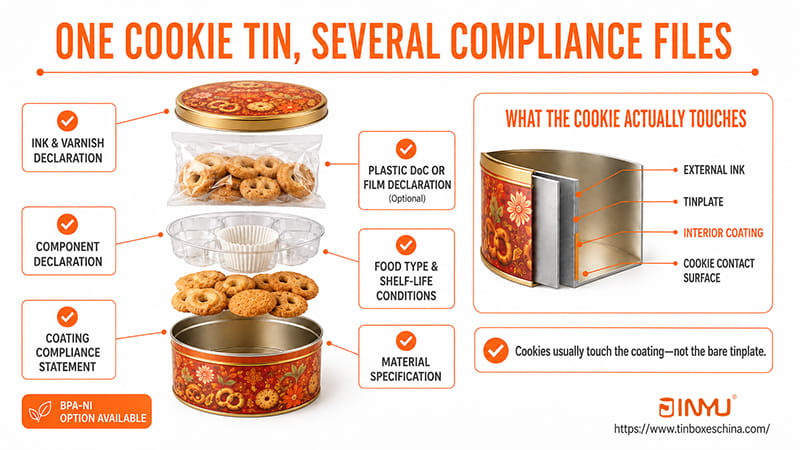
The final package may consist of four or five different material systems. None of this is covered by a metal tin report automatically.
Request documentation to determine: For a PET tray
Usually, projects in the EU require documentation for plastic components according to regulation (EU) No 10/2011.
Details of material and processing matter. Migrants from virgin and recycled PET trays were studied, and it was found that the profiles of migrants were affected by the ratios of recycled content and the manufacturing technology.
A report for generic PET is not as useful as one tied to the material used in the production tray.
The term PE bag rarely tells the whole story about the material.
Flexible bags can include multiple layers, printing inks, adhesives, coatings and sealant materials. Request the full structure of the film and declaration of food contact of the side in contact with the cookies.
The document shall also contain the actual use conditions. A film made for short term contact with dry food may not be automatically suitable for a longer shelf life or a biscuit with a higher fat content.
The bag must be filled and sealed and then tested. The gussets, headspace and folded seals affect the package dimensions, so the approved bag should also be used in the physical pack-out test.
Read How Many Cookies Fit in a Tin? for more on calculating the space taken up by cookies and inner packaging.
Paper inserts sound simple enough, but the word paper tells the buyer very little.
The review may have to consider:
A divider that separates two flavors still counts as a food contact component if the cookies touch it.
Studies on the migration of perfluoroalkyl acids from food packaging showed that migration was dependent on the type of paper, the time of contact and the food simulant used. This is not to be applied as a universal result for all paper cups, but explains why fiber type and surface treatment should be identified.
Reasonable test conditions are also needed for testing dry-food packaging. For example, a study on the migration of mineral oil from paperboard into dry-food simulants shows how the choice of simulant can influence the interpretation of results.
The selection of PET trays, paper dividers, paper cups and inner bags should be made prior to final compliance approval. Changing an insert later impacts the document pack and available capacity. Further comparison of these options is covered in Cookie Tin Inserts Compared.
The majority of cookie-tin art is printed on the outside, but production controls are still important.
They are made up in tins, but the sheets may be stacked during printing and manufacturing. A set-off is when substances transfer to another surface due to a poorly cured printed surface.
EU good manufacturing practice rules require controls to prevent unacceptable transfer from the printed surface. Research into packaging set-off using a simulation method also found that transfer in the system studied was affected by the curing conditions.
That research was not a test of a completed metal cookie tin. The real-world takeaway is to make sure the ink system is cured correctly and that the printing process does not cause the ink to move to the food contact side.
It is important not to dismiss dry food as irrelevant to print-related migration. In a Belgian study, migration of photoinitiator from printed packaging into food was found in paper and board applications with packaged foods.
Metal, paper and plastic all give different pathways for transfer, so you can’t just copy results from one to the other. They do endorse the need for correct ink choice and controlled printing processes.
There is no single document that covers all countries.
Food-contact materials placed on the EU market must satisfy the general safety requirements of Regulation (EC) No 1935/2004 and be manufactured according to Regulation (EC) No 2023/2006 on good manufacturing practice.
There are harmonized rules for plastics in the EU, but not for all metals, paper, coatings and printing inks under one identical material-specific measure. National provisions or other accepted technical guidance may also have to be taken into account.
That difference makes a difference in the paperwork. Regulation (EU) No 10/2011 requires a formal plastic DoC for applicable plastic components. A coated metal tin does not necessarily have to be in the same prescribed DoC format.
Buyers should still request a product-specific compliance statement for the coated tin and keep the supporting evidence.
Regulation (EU) 2025/40 on packaging and packaging waste also includes packaging requirements relevant to issues such as PFAS in food-contact packaging, and certain heavy metals. These packaging rules are above and beyond, not instead of, food contact rules.
‘UK compliant’ is not a term to be used without stating to which territory it applies.
Northern Ireland continues to apply the relevant EU rules on food contact under the applicable arrangements. Great Britain – i.e. England, Scotland and Wales – has a different regulatory position in some areas.
For example, the current UK government guidance explains that the newer EU BPA restrictions apply in the EU and Northern Ireland, but they do not currently apply in Great Britain in the same way. BPA in Food-Contact Materials: EU Regulations and UK Impact.
If a product is going to be sold in both Great Britain and Northern Ireland, ask for the compliance position to be mapped separately.
The FDA does not provide one single “FDA food-grade certificate” for all finished cookie tins.
"Rather, substances used in a food-contact article must have a proper regulatory basis for their intended use. may be based on a regulation in Title 21 of the Code of Federal Regulations, an effective Food Contact Notification or other recognized basis.
This process is outlined by the FDA in “Determining the Regulatory Status of Components of a Food Contact Material.”
If a supplier refers to a section of 21 CFR ask how it pertains to the actual coating, plastic or adhesive . Simply citing a number of a regulation does not demonstrate that the final construction is appropriate for the cookies and storage conditions at issue.
Where applicable, California Proposition 65 should be addressed separately. This is not an FDA food contact status replacement.
Food Standards Australia New Zealand takes an intended use approach. 1. Packaging shall be suitable for the intended purpose and shall not contaminate the food in such a way as to make it unsafe or unfit for human consumption.
The review should consider direct and indirect contact, composition of food, temperature, duration of storage and foreseeable reuse. The official FSANZ food-packaging guidance is a useful starting point.
An EU document may help in the assessment but should not be taken as satisfying any or all Australian or New Zealand responsibility.
A migration report is usually far more than most buyers need to see. They do have to make sure that the report is for their project.
Begin with seven questions:
Search for a product name, coating code, film structure or material reference.
Confirm the sample is representative of the coating, tray, bag or paper component being ordered.
The test conditions should be logical for the cookie you want.
A short test at room temperature and a long ambient shelf life are not automatically equivalent.
Specific migration, overall migration, heavy-metal content, metal release and composition screening generally address different questions.
The report shall specify the limit, unit, measured result and reporting/quantification level that apply.
A report prepared for one market should not be offered as global endorsement.
“Not detected” does not indicate that a substance has been proven to be absent. This indicates it was not detected above the detection or quantitation capability stated for the method.
An old report is not necessarily invalid, either. The more important question is if the material, formulation, supplier, use conditions and applicable legislation has changed.
Several documents are useful during supplier qualification but they do not prove the same.
ISO 9001 is about the supplier’s quality-management system. It may support consistency and process control but does not prove a particular coating is suitable for food contact.
The programs are mainly focused on social responsibility and supply chain practices. Chemical migration is not measured.
These are regulations. These are testing and inspection bodies. Their reports can be good evidence, but the buyer still needs to read the description of the sample and the scope of testing.
Even a report with the logo of a well-known laboratory can be incorrect about the coating or component.
Safety Data Sheets provide information on chemical handling and hazards. It is usually not a full food-contact declaration and may not reveal the full formulation.
REACH may be applicable for chemical restrictions in the EU. RoHS applies to specified electrical and electronic apparatus. Neither replaces a cookie tin food-contact assessment.
Heavy-metal testing is a common query, but it should not be viewed as the only food-contact test.
Content testing, metal release and migration are different types of tests. The scope needed is market, packaging material and customer specification dependent.
There’s no reliable universal price or turnaround time for testing, either. Laboratory costs and timings depend on the analytes, standards, quantities of samples, test conditions and location of the laboratory. Get a project specific quote before putting testing time into the launch schedule.
Let’s take a project for example:
A brand wants to pack 12 butter cookies in paper cups inside a coated round tin. There is no inner sealed bag. The shelf life is nine months at ambient temperature and the product will be commercialized in the EU and Great Britain.
The first supplier file contains:
The file looks large, but it doesn’t answer the main question: what will the cookies touch?
The missing information may be . . .
The answer is not to ask for “more certificates.” The answer is to ask for the right evidence for each piece.
(Note: This is an illustrative example, not a description of any specific Jinyu customer project.) It tells them what sort of mismatch to look for when they review supplier files.
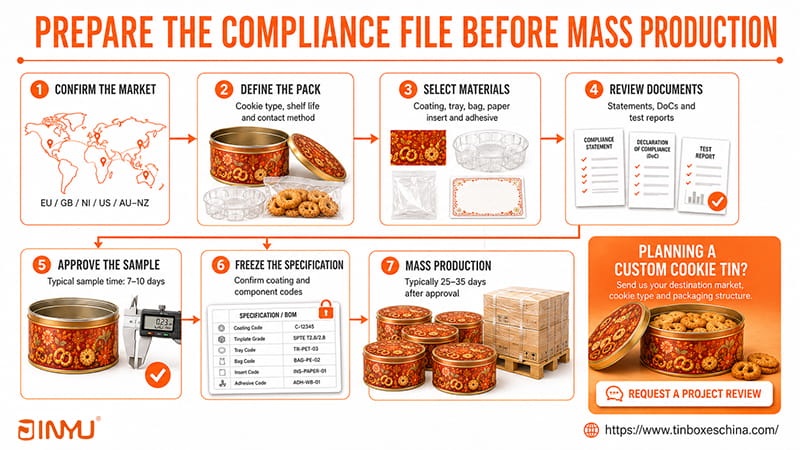
If compliance questions are raised after printing or production has started, they’re more expensive.
A reasonable sequence is:
At Jinyu, we generally require a MOQ of 5,000 pcs per size and design for custom printed cookie tins. Samples usually 7-10days,mass production usually 25-35days after your deposit received.
Do not confuse such standard timeframes with third party laboratory testing. Any further testing required should be confirmed for scope and timing before finalization of the launch schedule.
Food contact requirements may also impact cost. Change of coating, tray, bag or paper insert can also change the quotation and the compliance file. To see a more detailed breakdown, see What Determines the Cost of Custom Cookie Tins?.
The following text can be used for RFQs or samples emails:
Please submit the food-contact compliance documents for the proposed cookie-tin construction.
Item: [type of cookie or biscuit]
Packing system: [direct contact / paper cup / PET tray / sealed inner bag]
Shelf life: [time period]
Storage conditions: [temperature and other relevant conditions]
Target market: [country or region]
Please specify the tinplate, interior coating, exterior ink and varnish, tray, bag, paper insert and adhesive where applicable.
For each food-contact component please provide current compliance statement or Declaration of Compliance, supporting test reports, intended use restrictions, material or coating code, issue date and traceability reference.
Also please confirm that the sampling materials will be the same as the mass production materials and please inform us in advance of any material or supplier change.
The more specific the RFQ, the less likely you are to get a pile of generic certificates that you then have to review again.
If, during the approval process, you:
A single short specific file is often more useful than a large folder of unrelated reports.
When there is a change to Recheck compliance file
Don’t count on a set expiry date. A more compelling reason for review is a material or use change that is relevant rather than the age of the PDF alone.
No. Requirements vary according to destination market, material and use. Usually, a complete file contains a number of component-specific documents.
The bag becomes the primary contact layer, but the overall packaging configuration still needs to be checked. Relevant also may be foreseeable contact after opening and reusable storage claims.
There is no FDA certificate that covers every finished cookie tin. Ask for the basis for the regulation of each food-contact component and its intended use.
No sir. The review isn’t just about heavy-metal content or release. Evidence for the coating, plastic components, paper inserts, intended-use restrictions and relevant migrants may be required separately.
Yes, when they touch the food. Fiber source, additives, printing, adhesives, surface treatments may all be relevant.
There is not a universal period. Still representative of the current material, supplier, manufacturing process, use conditions and legislation in force.
The package manufacturer shall submit correct information about material and production. The importer, brand owner or food business operator should ensure that the final packaging is suitable for the product and the market it is destined for. Complex projects may require specialist laboratory or legal advice.
The question that is useful is
“Have you got a food grade certificate?”
It's:
“Can you prove that the coating and all other food contact parts in this particular cookie tin are suitable for this food, this storage condition and this destination market?”
There should be a clear paper trail linking:
finished tin → component specification → coating or material code → statement of compliance → supporting report → production batch
When you ask Jinyu for a quotation, please tell us the destination market, cookie type, expected shelf life, contact arrangement and insert requirements. In this case we can then review the proposed packaging structure, identify the documents that are already available and flag areas that may need confirmation prior to sampling or mass production.
Check out our bespoke cookie and biscuit tin boxes or send us your packaging spec and we’ll review your project.
European Commission. Food Contact Materials.
European Union. Regulation (EC) No 1935/2004 on Materials and Articles Intended to Come into Contact with Food.
European Union. Regulation (EC) No 2023/2006 on Good Manufacturing Practice for Food-Contact Materials.
European Union. Regulation (EU) No 10/2011 on Plastic Food-Contact Materials.
European Union. Regulation (EU) 2024/3190 on BPA and Other Bisphenols in Food-Contact Materials.
European Union. Regulation (EU) 2025/40 on Packaging and Packaging Waste.
UK Government. BPA in Food-Contact Materials: EU Rules and UK Implications.
US Food and Drug Administration. Determining the Regulatory Status of Components of a Food Contact Material.
Food Standards Australia New Zealand. Food Packaging.
Kang, J.H., Kito, K. and Kondo, F. (2003). Factors Influencing the Migration of Bisphenol A from Cans. Journal of Food Protection, 66(8), 1444–1447.
Vázquez-Loureiro, P. et al. (2023). Investigation of Migrants from Can Coatings: Occurrence in Canned Foodstuffs and Exposure Assessment. Food Packaging and Shelf Life, 40, 101183.
Colombo, S., Corredig, M., Uysal Ünalan, I. and Tsochatzis, E.D. (2024). Untargeted Screening of NIAS and Cyclic Oligomers Migrating from Virgin and Recycled PET Food Trays. Food Packaging and Shelf Life, 41, 101227.
Xu, Y., Noonan, G.O. and Begley, T.H. (2013). Migration of Perfluoroalkyl Acids from Food Packaging to Food Simulants. Food Additives & Contaminants: Part A, 30(5), 899–908.
Fengler, R. and Gruber, L. (2022). Migration of Mineral Oil Hydrocarbons from Contaminated Paperboard into the Food Simulants Tenax and Sorb-Star—A Comparison. Packaging Technology and Science, 35(8), 603–620.
Lemos, A.B. et al. (2017). Set-off: Development of a Simulation Press and Analytical Approach to Study the Phenomenon. Packaging Technology and Science, 30, 495–504.
Van Den Houwe, K. et al. (2016). Migration of 17 Photoinitiators from Printing Inks and Cardboard into Packaged Food—Results of a Belgian Market Survey. Packag ing Technology and Science, 29, 121–131.

Obtenez les dernières informations et offres spéciales


 Réseau IPv6 pris en charge
 Français
 English
 Deutsch
 Español
 Português