
The lid seems finished until someone adds the second language. The name of the flavour gets smaller, the barcode moves to one side and the batch code loses space. A few late additions can change the whole small mint tin.
Use the approved product copy and actual tin drawing. Make room for the barcode and production codes and build the brand presentation around it. The tin has to be printed, formed, filled and sealed and then it all has to work.
Sales markets, languages and retail unit confirmed. Will customers buy the tin by itself or as part of a larger pack? That decision is in the brief before anyone starts moving text around panels.
Obtain the full approved copy from the product owner for: food name, net quantity, ingredients, applicable allergen and nutrition information, business information and any required warnings. Sugar free mints need special attention as the formulation may result in sweetener declarations or other statements.
Placement matters, too. EU rules generally require the food name and net quantity to be in the same field of vision. US rules specify a principal display panel and an information panel with placement requirements and exceptions. “Put all legal text underneath” is not a one-solution-fits-all. US information panel regulations EU food information regulations.
The regulatory reviewer for the brand should confirm the required content and placement. The tin supplier checks how that layout can be manufactured.
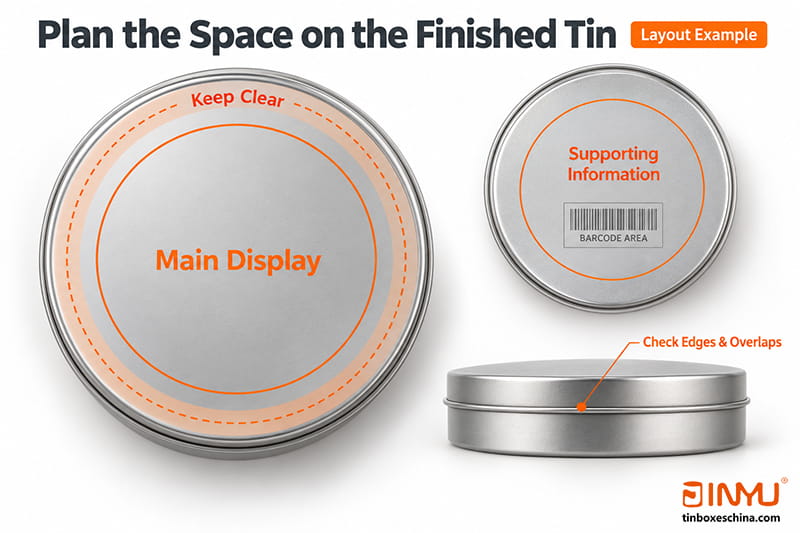
The geometric area of a 60 mm round face is approximately 2,827 mm2. It doesn't give you that much room for text without breaks. The usable area is reduced by cutouts , rolled edges and structural features .
Request the supplier for the artwork template for the specific tin design. Mark lid overlap, hinge or slide tracks, embossed areas and any seal-label location. If a format has still to be decided, sort out the mint tin size and filled-pack fit along with the artwork.
| Surface | Potential use | Verify before assigning it |
| Main lid front face | Food name, flavour, brand and display information required | Curvature of the edge, embossing and seal coverage |
| Flat base | Product copy, barcodes or production codes where permitted | Niches , edges and leftover useful dimensions |
| Body side | Short IDs or supplementary information | Seams, curvature and overlapping of lids |
| Inside cover | Optional brand content | Suitability for food contact and printability |
The bleed, text safety margins and barcode quiet zone all serve different purposes. Keep them separate on the drawing. One “3 mm margin” cannot define all three.
Imagine a 60 mm round tin for three flavours and two markets. This is a design exercise, not a customer project.
Start with brand, food name and taste. Add a slogan or illustration and place any information that needs to accompany them. A small flavour name needs contrast and breathing room, not necessarily a bigger logo alongside.
Use colour to enhance the flavour name, not replace it. Use the same name in the same place in the range.
For this example, first take out the long promotional sentence from the lid. Then, look at the decorative border. And you don't want to force it to create a curved edge.
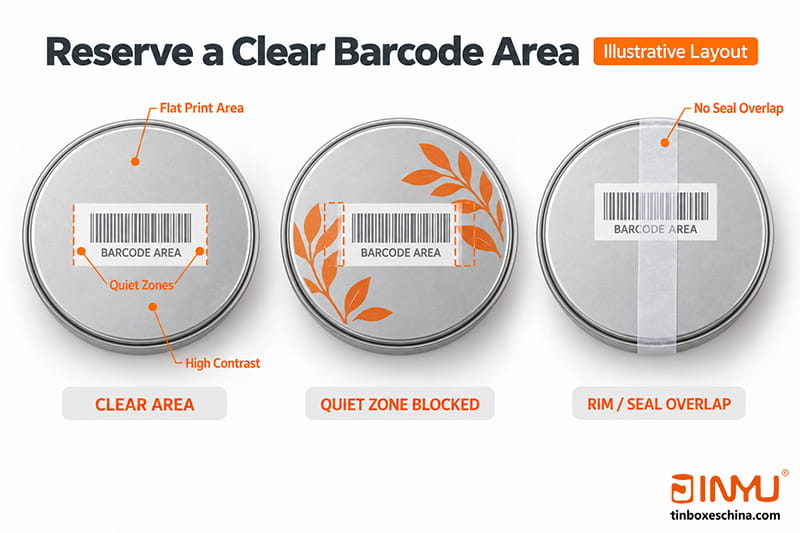
A barcode is not an illustration that can be squeezed into an empty corner.
Get the right code from the brand owner and create artwork to the desired spec. The size depends on the symbol, the scanning application and the printing conditions. Note the required height and quiet zones. Shortening the bars is not a commonplace space saving measure. These requirements are described in GS1’s guidance on barcode printing.
If the tin is metal, check the following:
A suitable surface, without seams, rims and relief.
Dark bars on a solid light background with good contrast.
No seal label, film overlap or subsequent printing across the symbol or quiet zones.
Human readable numbers corresponding to the encoded data.
An opaque white patch with black is a good place to start. Controlled background is not a good substitute for exposed reflective metal. Curved side needs to be looked at for diameter, symbol size and orientation. Base needs to be checked, not auto-approved.
Print the artwork at full size and hold up to sample tin. This picks up problems masked by a large monitor although paper can not reproduce the final metal finish.
Choose letterforms with identifiable characters and enough stroke weight. Discuss small reversed out type and multicolour lettering with the printer. A nice screen proof does not guarantee legibility in production.
Never have “5 pt minimum” as an absolute. The point size is not equivalent to the x-height. As a general rule of the EU, relevant mandatory text must have an x-height of minimum 1.2 mm (reduced to 0.9 mm where the largest surface of the packaging is less than 80 cm2), subject to applicable provisions. Regulation (EU) No 1169/2011, Article 13
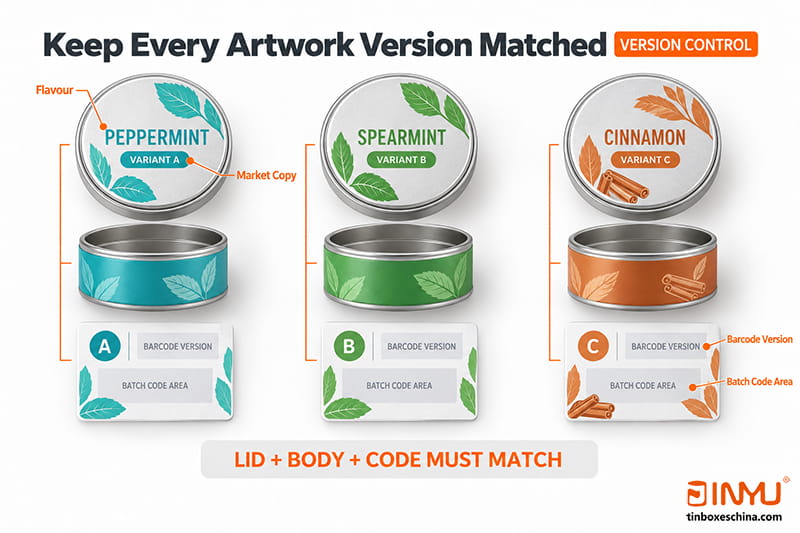
Leave space for batch code and date marking as appropriate. Ask the filler about where and when these will be applied, how much room the actual text is going to take up, and whether the finish you select accepts the marking process. Include the code in the approval sample.
Identify a common layout among identical printed content for multiple flavours. The different product codes require corresponding changes in the barcode pattern and the human-readable numbers. Ingredients and warnings may also vary.
In our example, the three lids share a design system, but each market version has its own approved copy and code. Check the lid, body and label applied together. A correct peppermint lid on the incorrect body is still the incorrect pack.
First cut optional text then necessary text . Separate market versions: Compare. Peel-and-reveal label where allowed. Outer sleeve or carton. Confirm the labelling rules for the resulting sales unit, and choose one.
A website QR code can tell a brand story of a longer length. This should not be assumed to replace required on-pack information or the checkout barcode. GS1-compliant retail QR codes are not just a link to a landing page, but the right encoding and retailer support. GS1 guidance on transition to 2D barcodes.
Check inside-lid printing separately. Loose mints may touch the lid when a tin is turned over. “Don’t just transfer over an exterior ink specification there without evaluating the ink, coating and final structure for food contact.” The EU GMP rules for printing inks require transfer from non-food contact printing and to keep those printed surfaces away from direct contact with food.
An inner pouch also needs to be considered after opening, especially if the consumer might pour the mints out into the tin.
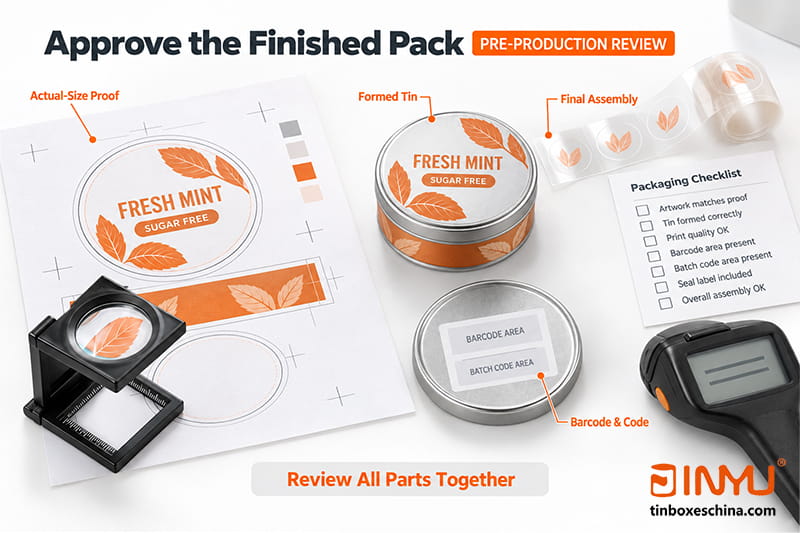
Assemble every proposed flavour and market version with its real label, closure seal and production marking. Approve the artwork with those parts in place.
| Review: | Proof for verification |
| Contents and version | Approved copy, flavour, product code and artwork revision |
| Printing and Moulding | full size lettering colour edge position and emboss registration |
| Barcode | Correct number decoded and appropriate quality verification |
| Final assembly | No hidden text trapped labels or interference from seals |
| Production stamp | Lot/date code readable in agreed position |
A paper proof is used to proof layout. Render confirms appearance. Neither one shows the scanning performance of a glossy, formed tin.
Phone scan is a good spot check, but it is not a substitute for proper barcode verification. GS1 also recommends to review the final formed product and verify that the shrink-wrap, tape and other printing are not obscuring the code. GS1 barcodes list.
Keep together the approved artwork, sample and version record. Changes to the code, finish, label or seal may require new checks.
In an appropriate location that is accessible and has space for the complete symbol and quiet zones. Compare the base and the sides to the finished structure.
Yes, if the background, contrast, dimensions and print quality are correct and checked on the final pack.
There is not any standard point size. Check market requirements, actual letter size and legibility of production
Yes, a QR code can save space. QR codes can store much more information than a typical barcode, and they can be scanned with a smartphone.
It can push optional content to the web. The replacement of mandatory information or retail barcode requires a separate assessment.
Yes. Product specific copy, codes and component matching still need individual approval.
The correct template, editable artwork, approved copy and barcode files, specifications for colours, white ink, embossing, labels and variable codes.
For Jinyu mint and gum tin formats please send selected size, sales markets, languages, approved copy, barcode files and number of artwork versions. Requirements for marking and closure seals.
Preview printable areas and production feasibility before sampling. Send us your brief for an artwork review. Custom Print Orders Starting at 5,000 Pieces Please Confirm Quantities for Each Size & Version of Artwork
European Union Regulation (EU) No 1169/2011 on the provision of food information to consumers.
US eCFR — 21 CFR 101.2 Information panel of package form food.
Obtenez les dernières informations et offres spéciales


 Réseau IPv6 pris en charge
 Français
 English
 Deutsch
 Español
 Português