
A dark gift tin may look great at sample approval and show pale rub marks after packing. The supplier looks straight down at the lid and sees little difference, the buyer sees them in angled light. An order that is “scratch resistant” does not offer any party a clear standard for what is acceptable.
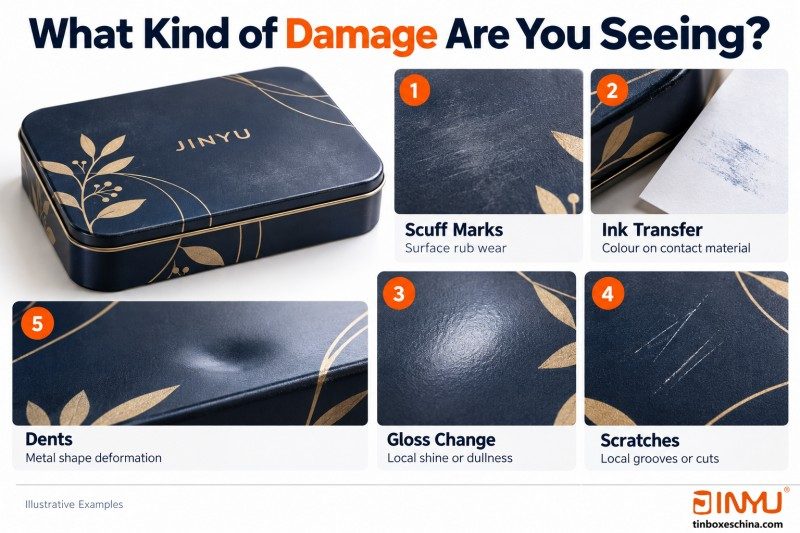
“The print is damaged” can be used to describe several different problems:
Record location and time of damage: After forming, bagging, carton packing or shipping. "Repeated marks near the embossed logo could be contact points worth investigating." This does not show that the varnish is unsuitable. Better print wear performance is not achieved solely by increasing tinplate thickness.
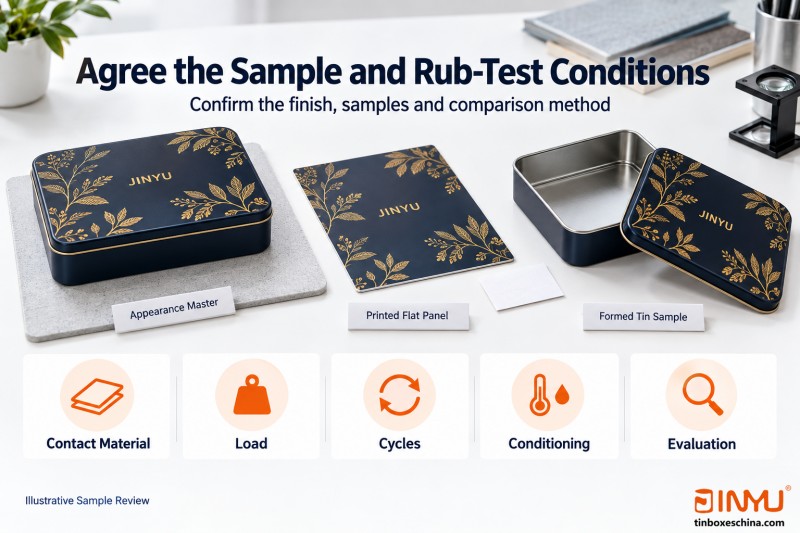
A sample is no use unless both parties know what it stands for. Note substrate, ink and coating system, finish, production route and its age and conditioning at the time of test. Curing requirements are system dependent and there is no substitute for the proper process controls as a general waiting period.
| Sample | What it can prove | What remains to be checked |
| Digital mock-up | Artwork layout and information placement | Real finish and wear performance |
| Flat Panel Print | Comparison of ink and coating performance on a flat surface | Formation, edges, curves and packing contacts |
| Tin printed pre production | Closure contacts, proposed packing and appearance of formed | The representativeness of the production pathway |
| Sample of production batch | Condition of production | Sampling and acceptance procedures as agreed |
| Boundary Samples | Examples of Acceptable and Unacceptable Appearance | Viewing conditions, zones and defect definitions applicable |
Keep a pristine master separate from samples used for rubbing or transport tests. Both parties should have the same references identified. Photographs assist in recording a mark, but reflections and gloss make them a poor substitute for the actual tin.
“Passed 100 rubs” is too general. Rubbing on a paper interleaf is not the same as rubbing on another tin, even at the same cycle count.
Before testing agree the following:
ASTM D5264 is a comparative abrasion test for printing on flat substrates. Its public scope includes Sutherland Rub Tester or equivalent apparatus and standardized receptors. This makes it relevant for flat printed tinplate comparisons, and does not automatically qualify performance at a formed corner or raised logo. If a special fixture or changed contact material is required, document the modification. A modified procedure is not considered a full compliance with the standard.
ASTM D3363 measures the hardness of the coating film by pencils. A hardness result can back a coating discussion but it does not show how a tin will behave against its actual packing materials. Take the test which is suitable for the problem to be investigated. store.astm. com
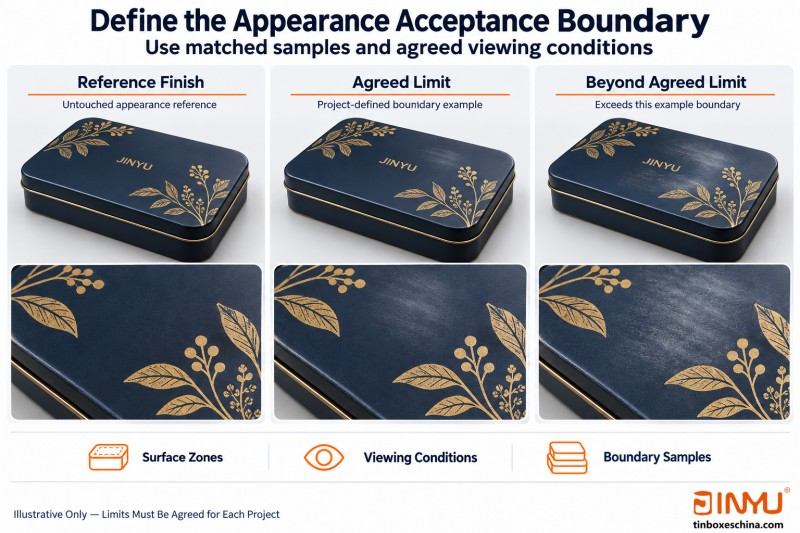
The useful question is whether a mark meets an agreed requirement in its location. A tighter appearance limit could be needed for the main lid image than for a concealed base area. No limitation is to be assumed.
Make the agreement tangible with a surface diagram and physical boundary samples.
| Agreement item | To record |
| Product and sample identity | SKU, drawing and artwork versions, finish and reference samples |
| Inspection stage | Prior to protective packing, after carton packing or after specified transport test |
| Surface zones | Distinct brand zones, information panels and other surfaces |
| Viewing Conditions | Lighting, distance, angle, inspection time and any magnification |
| Appearance boundaries | Examples of acceptable and rejected; limits on mark size or count where agreed |
| Information performance | Legibility requirements Separate barcode verification |
| Touch test requirement | Method, contact material, load, number of cycles and evaluation rule |
| Lot decision | Lot definition, sample size, defect classification and acceptance/rejection criteria |
For example a project may state that the main logo should be legible as per the agreed test and that the lid scuffing should be no worse than the identified acceptance-limit sample. That’s a project requirement, not a blanket industry standard.
Rub-test result for a specimen is a separate decision from appearance inspection for a lot. Write how each will be judged.
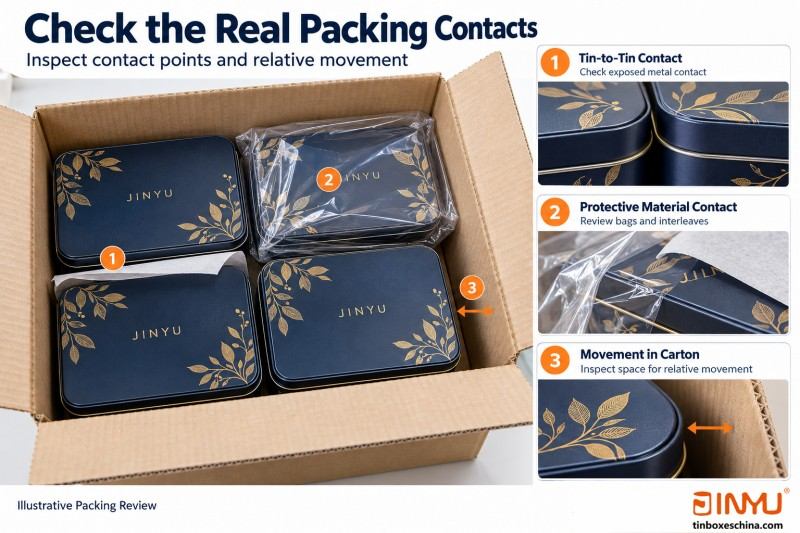
Ignore the top coat. Contact points are formed by the forming equipment, handling, lid-to-body contact, nesting and embossed features. Bags, interleaves and carton surfaces also need to be checked with the proposed finish. Adding a bag doesn't automatically stop wear.
Check packing arrangement for relative movement, exposed metal contact, contamination and change in protective materials. When comparing, keep product, inserts, carton configuration and other relevant packing details the same.
ASTM D4169 deals with the performance of shipping units through a series of expected distribution hazards. So a transport evaluation must reflect the intended distribution environment and the actual shipping pack. It's an addition to a rub test, not a replacement. store.astm.org
Now, let’s imagine a hypothetical Jinyu design review, not a recorded customer outcome.
A rectangular gift tin with a dark matte lid and a large brand image on it. Appearance sample approved, but packed samples have pale marks. The purchase specification doesn’t say anything beyond “scratch resistant.”
The review distinguishes between samples checked before packing, after packing and after the proposed transport assessment. The points of contact in the pack are compared to mark positions.
One test does not change the printed finish and compares alternative protective arrangements. If that's not enough, a different trial compares a revised topcoat with packing held constant. But if both were changed at once, it would be more difficult to identify the source of any improvement.
The same surface zones, viewing conditions and boundary samples are used to judge each option. The practical outcome is an accepted finish and packing combination including documentary proof and acceptance rules. If you want to claim "50% better", you need to have defined measurements and test logs.
Attach the approved references and the test requirements to the order. The coating system and protective materials and packing configuration, including any changes requiring renewed approval.
Choose inspection samples that are representative of the lot, not the most attractive tins. ASQ’s sampling guidance discusses the importance of representativeness and selection bias when making inferences about the larger population. There is no one sample size that will work for every order. ASQ
Agree on who reviews a failed lot and authorizes sorting or other remedies. Confirm reference versions and condition on reorders. These requirements should be the same when price comparisons are made. They form part of the material and packing specifications when tin packaging quotations are compared on the same specification.
Agree method, contact surface, load, cycles, conditioning and evaluation Check relevant formed and packed configurations using representative printed samples.
It can approve layout. It can not show the finish of the physical coating or its rub resistance.
No. Pencil hardness and wear against actual packing surfaces are different aspects of the performance of the coating.
There is no single ranking for all. Compare the real coating systems and the wear looks of them under the agreed conditions.
Identity, surface areas, viewing conditions, limits of appearance, test conditions, information requirements, and lot acceptance criteria as examples.
Yes. The loads, motions and contacts imposed by shipping may be different to those imposed by lab testing. Examine the whole packing arrangement.
Got a printing tin project in mind? Send the drawing, artwork, finish, packing arrangement and any scuff samples to Jinyu. Please forward the proposed samples and tests together with their intended use, shipping conditions and existing acceptance requirements for review.

Obtenez les dernières informations et offres spéciales


 Réseau IPv6 pris en charge
 Français
 English
 Deutsch
 Español
 Português