
Chocolate packaging has to do more than look attractive. It has to protect a delicate product, support a premium buying experience and communicate quality for the brand before the first piece is tasted.
When it comes to packaging that feels more durable, gift-ready, reusable, and visually memorable, custom chocolate tins are a common choice for chocolate brands. Compared to simple paperboard boxes or flexible pouches, metal tins possess a more durable outer structure and a more collectible presentation.
However, choosing the right chocolate tin is not only about its pretty shape. Chocolate is sensitive to heat, moisture, oxygen, odor, pressure and surface damage. For a successful tin packaging project, you should consider the type of chocolate, inner structure, food-contact safety, lid design, printing finish, MOQ, tooling cost and the sales channel.
This guide explains how chocolate brands and packaging buyers can choose custom chocolate tins more effectively.
Chocolate is closely linked to gifting, indulgence, celebration, and emotion. The packaging often shapes the consumer’s first judgment of the product’s quality and value.
Custom chocolate tins offer several advantages for premium chocolate brands:
A well-designed chocolate tin can make the product feel more special without requiring additional gift wrapping. This is why metal tins are commonly used for Valentine’s Day chocolates, Christmas assortments, corporate gifts, limited editions, truffle collections, and premium retail lines.
For many customers, the tin is kept after the chocolate is gone. This gives the packaging a second life and keeps the brand visible for longer.
A common mistake in chocolate tin sourcing is choosing the tin shape first. In reality, packaging should start with the chocolate format.
Different chocolate products require different structures.
| Chocolate Type | Packaging Challenge | Recommended Tin Packaging Approach |
| Truffles and pralines | Fragile surface, easy to scratch or shift | Use shallow tins with molded trays, paper cups, or dividers |
| Chocolate bars | Need flat protection and clear branding | Use rectangular tins, slim tins, or flat insert structures |
| Assorted chocolates | Multiple flavors need visual organization | Use compartment trays or multi-layer dividers |
| Filled chocolates | Sensitive to pressure, movement, and odor transfer | Use snug inserts, inner wraps, or sealed pouches |
| Seasonal gift chocolates | Need emotional impact and shelf attraction | Use heart-shaped, round, custom-shaped, or decorative tins |
| Corporate chocolate gifts | Need logo, message, and premium presentation | Use clean printing, embossing, inside-lid printing, or message cards |
A chocolate tin should be designed around the product’s size, height, shape, quantity, and fragility. Before mass production, it is best to test the tin with real chocolate samples or accurate dummy samples.
For example, a tin that works for individually wrapped chocolate bars may not work for handmade truffles. A heart-shaped tin may look perfect for Valentine’s Day, but if the internal tray cannot hold the chocolates securely, the final customer experience may still fail.
Chocolate is more sensitive than many dry food products. Packaging must help reduce risks during storage, transport, retail display, and consumer handling.
High temperatures cause chocolate to melt or lose its shape. Metal tins offer some structure but don’t replace proper storage and shipping temperature control. Brands shipping into warm climates or online should consider insulated shipping, seasonal shipping rules or appropriate inner wraps.
Moisture can affect the texture and appearance of chocolate. This can occasionally result in sugar bloom, which gives the chocolate a dull or whitish appearance. This risk can be minimized by using the appropriate storage conditions, inner wrappers, liners and sealed pouches.
Chocolate has fats that can absorb odors from its environment. Chocolate can also lose flavor quality if stored in less than ideal conditions. This is particularly true of chocolate with nuts, citrus, coffee, spices or delicate fillings.
Light can ruin the quality and change the look of chocolate over time. Opaque metal tins offer better protection from light than transparent packaging. If a window is used, brands should evaluate whether product visibility is worth the reduced light protection.
Truffles, pralines, decorated chocolates, and filled pieces can be damaged if they move inside the package. A beautiful tin cannot protect chocolate properly without the right internal structure.
For this reason, many chocolate tin projects combine a metal outer tin with an inner tray, divider, paper liner, foil wrap, or sealed pouch.
The inside of a chocolate tin is often as important as the outside.
A premium tin may look attractive on the shelf, but if the chocolates shift, collide, or lose their arrangement during shipping, the customer experience will suffer. The inner packaging secures the chocolates, separates the flavours, improves the overall presentation and reduces damage.
| Inner Structure | Best For | Main Benefit |
| PET or PP tray | Truffles, pralines, molded chocolates | Holds each piece in a fixed position and improves display |
| Paperboard divider | Assorted chocolates and multi-flavor sets | Separates flavors and reduces friction |
| Molded pulp insert | Eco-conscious gift packaging | Reduces plastic use while keeping products organized |
| Candy pad or layer pad | Multi-layer chocolate tins | Helps separate layers and reduce surface contact |
| Paper cup | Individual truffles and pralines | Improves hygiene and presentation |
| Foil wrap | Chocolate bars or premium pieces | Helps protect against moisture, odor, and handling |
| Inner pouch | Premium chocolates, export packaging, aroma-sensitive products | Adds freshness protection and separates food from the tin |
| Flocked or premium insert | Luxury chocolate gift sets | Enhances visual presentation and perceived value |
The choice of insert depends on the product’s fragility, target price level, filling process, sales channel, and sustainability goals.
For e-commerce or export projects, the inner structure should be tested more carefully as the package may face repeated handling, vibration, stacking and temperature changes. For retail gift products, the appearance after opening is as important as protection during transit.
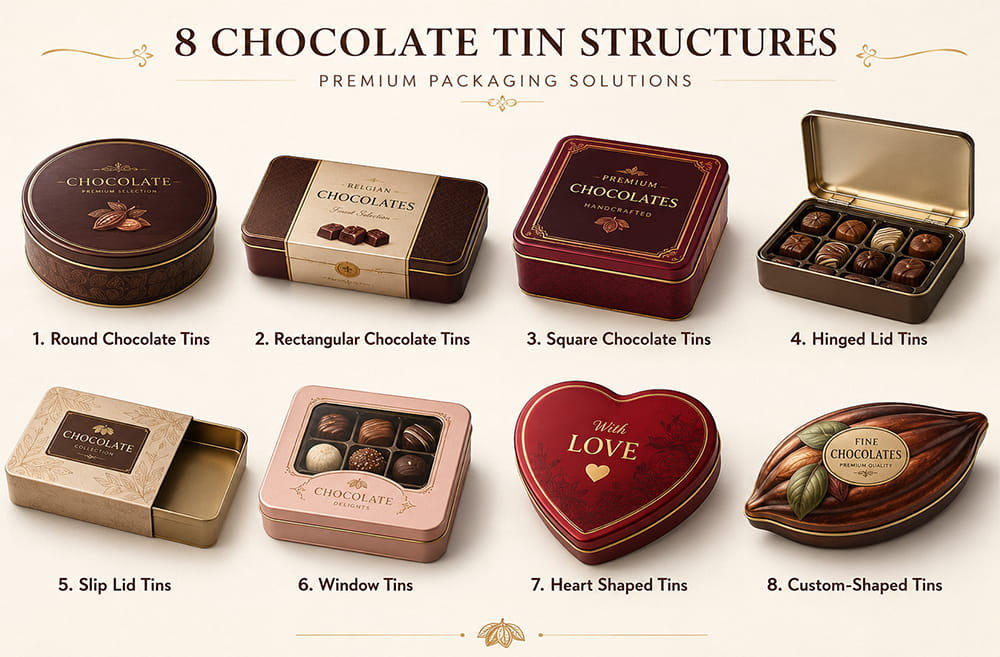
Chocolate tins come in a variety of shapes and structures. The selection of a suitable chocolate tin depends upon the product format, brand positioning, production budget and launch timings.
The traditional gift look in a round tin, suitable for assorted chocolates, seasonal collections and reusable packaging. They look soft and friendly, but may be less efficient for carton packing than square or rectangular tins.
Chocolate bars, praline sets, flat assortments and gift packs are all practical for rectangular tins. They are generally easier to stack, display and carton-pack than others and thus make a good choice for wholesale and export orders.
Square tins give a well-balanced look on the shelf and work well for truffles, assortments and premium gift sets. They offer a more structured layout but still feel gift-ready.
A hinged lid tin offers a convenient opening experience, and ensures that the lid is not lost. They are ideal for reusable gift packaging and for products a customer may need to open and close multiple times.
Slip lid tins are simple, cost effective and widely used for standard chocolate gift formats. They are suitable when brands need a clean appearance and stable production cost.
These tins have a window so customers can see the chocolates inside. They may be good for colorful or decorative chocolates but brands need to consider light exposure, material compatibility and food safety.
Heart shaped tins are often connected with Valentine’s Day and romantic gifting. They can immediately communicate emotion but generally need earlier planning as mold availability, MOQ and production time need to be checked.
Custom-shaped tins are a powerful tool for distinguishing limited editions, luxury launches, or signature brand products. They can also add cost to tooling, sample time, production complexity, and unit price.
The safest place to start for new chocolate brands is usually the standard round, square or rectangular tin. Custom molds are more suited to long-term product lines, high-volume seasonal campaigns or established premium brands.
Food safety should be discussed early in any chocolate tin packaging project.
Most chocolate tins are made from tinplate, a steel material coated with a thin layer of tin. For chocolate packaging, the tin often uses an internal coating or lacquer to separate the product from the metal surface.
However, in many chocolate packaging projects, the chocolate does not directly touch the tin. It is usually protected by:
If chocolate will directly contact the tin, buyers should confirm:
For high-fat chocolate, flavored chocolate, nut-filled chocolate, or chocolate with citrus, coffee, caramel, or cream fillings, the inner packaging system should be reviewed carefully. The goal is to reduce the risk of flavor transfer, odor absorption, or surface contamination.
For many brands, the safer and more practical solution is to use a food-safe inner tray, paper cup, foil wrap, or sealed pouch inside the decorative tin.
Chocolate is a very visual and emotional product category. Colors, textures, typography and surface finishes can have a direct impact on perceived value.
Some popular ways to customize chocolate tins are:
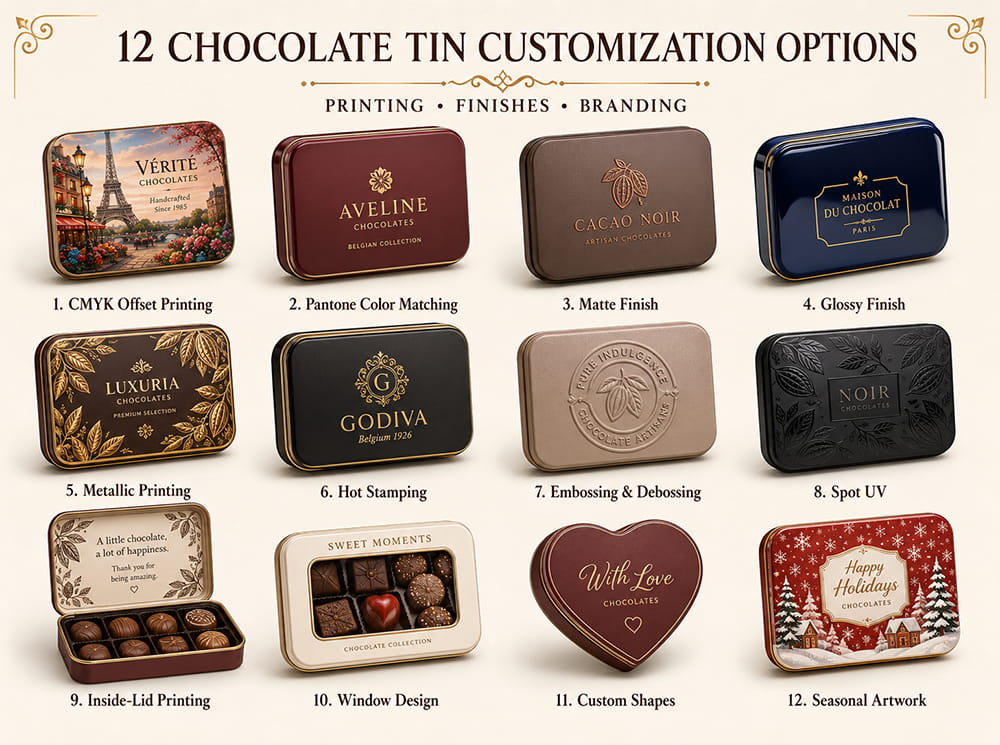
Different brands of chocolate could have different design directions.
| Brand Positioning | Suggested Design Direction |
| Luxury dark chocolate | Dark tones, metallic accents, embossing, minimalist typography |
| Artisan chocolate | Hand-drawn illustrations, cocoa origin graphics, matte finish |
| Organic chocolate | Earthy colors, botanical patterns, natural texture effects |
| Kids or fun chocolate | Bright colors, playful graphics, bold flavor cues |
| Corporate gifts | Clean logo placement, message area, refined finishes |
| Seasonal chocolates | Limited artwork, custom shapes, festive color palettes |
Printing on the inside lid is especially useful for chocolate tins sold as gifts. The inside lid can carry a greeting, brand story, flavor map, QR code, or seasonal message; this enriches the opening experience and makes it feel more complete.
If you are still exploring visual styles, seasonal concepts, color systems, or collectible packaging ideas, you may also read our related guide:
Custom chocolate tins are best used when the product is sold as a gift, collectible item or premium seasonal product.
Heart-shaped tins, floral designs, soft-touch finishes, romantic colours and keepsake packaging can make chocolates more special.
Decorative tins are perfect for seasonal gifting and sharing with family, decorated with seasonal patterns, metallic printing and reusable structures.
Pastels, florals, egg-shaped tins and whimsical illustrations will give you a fresh seasonal look.
Chocolate tins can be customised with logos, brand colours, thank you messages, QR codes or printing inside the lid. They are often used for client gifts, employee appreciation, events and product launches.
Choose small or personalized tins for premium favors. Names, dates, event colors or custom artwork can be carried on the packaging.
Metal tins are suitable for collectible chocolate packaging. A limited-edition tin can create urgency and increase perceived value.
In these scenarios, the tin is not only packaging. It becomes part of the gift itself.
Chocolate brands often compare metal tins with other packaging options. They all have their pros and cons and meet different needs.
| Packaging Type | Strengths | Limitations | Best Use |
| Chocolate tins | Strong protection, reusable, premium, recyclable, gift-ready | Higher initial cost; tooling may be required | Premium chocolates, gifts, seasonal collections |
| Paperboard boxes | Lightweight, printable, cost-efficient | Weaker crush resistance; often needs inner barrier | Retail chocolate bars and mid-range products |
| Rigid boxes | Luxury unboxing and strong presentation | Usually less reusable than tins; higher board cost | Premium assortments and gift boxes |
| Flexible pouches | Lightweight and economical | Lower premium feel; less structural protection | Snack chocolates and refill packs |
| Glass jars | Premium display and reusable appearance | Heavy, fragile, not ideal for many chocolate formats | Boutique display or specialty pieces |
This helps a brand balance cost, product protection, shelf presence and customer experience.
Size is not the only thing that affects the price of chocolate tins, the major cost factors are
Custom molds are a good option if you have a consistent demand, large seasonal campaigns or long-term product lines. Heart-shaped tins, special structures, and irregular shapes can improve differentiation but should be planned with enough time for tooling and sampling.
Buyers should not compare suppliers by unit price only. A lower-cost tin may become expensive if it causes product movement, poor lid fit, printing inconsistency, delayed delivery, or shipping damage.
The better question is not “Which tin is cheapest?” but “Which packaging structure protects the chocolate, fits the brand, and performs reliably in the real sales channel?”
Before confirming a chocolate tin supplier, brands should prepare the following information:
Useful questions to ask the supplier include:
A reliable supplier should help evaluate structure, protection, food safety, design feasibility, cost, and shipping performance, not just provide a quick quotation.
Custom chocolate tins are most valuable when packaging needs to combine protection, presentation, gift value, and long-term brand visibility.
The right tin should match:
A beautiful tin can attract attention, but a well-engineered chocolate tin protects the product, improves unboxing, supports retail display, and gives the customer something worth keeping.
When structure, safety, design, and sourcing are planned together, custom chocolate tins become more than containers. They become durable, reusable brand assets that help premium chocolates feel as special as they taste.
They may be, but it depends on the inner coating and food contact compliance They are often used in many chocolate packaging projects, with the chocolate being packed in foil, paper cups, trays or inner pouches before being placed inside the tin.
The most common tins are rectangular, square and round tins with heart-shaped tins popular for Valentine’s Day and custom-shaped tins suitable for limited-edition or luxury campaigns.
Metal tins give good outer protection and light proofing, but freshness also depends on the inner wrapping, trays, liners, sealing structure, and storage conditions. Foil wraps or inner pouches are often employed with the tin for premium chocolate.
No. A tin can protect from pressure and light but it cannot replace temperature controlled storage or shipping. Chocolate still needs to be handled properly in warm conditions.
Popular choices are PET trays, PP trays, paperboard dividers, molded pulp inserts, candy pads, paper cups, foil wraps and premium presentation inserts.
Yes, tinplate is recyclable and many consumers reuse chocolate tins for storage or gifting once the chocolates have been consumed.
New brands prefer existing molds because they are cheaper to tool and sample. Custom molds are preferable for established brands, seasonal campaigns and premium product lines.
Yes we can custom chocolate tin with CMYK printing, Pantone colors, metallic printing, embossing and de-bossing, matte or gloss finish, spot UV, printing inside the lid, windows and custom shapes.
If you are interested in chocolate tin packaging for truffles, pralines, chocolate bars, assortments, seasonal gifts or corporate programs please confirm first the product format, actual dimensions, any inner tray needs, food-contact requirements, artwork direction, order quantity and shipping destination.
The professional tin packaging manufacturer can assist in mold options, lid structure, insert design, printing finishes, sampling and export packing before mass production.
Contact us today to talk about your custom chocolate tin packaging project or to receive a sample.
Obtenez les dernières informations et offres spéciales


 Réseau IPv6 pris en charge
 Français
 English
 Deutsch
 Español
 Português