
Cookie tins help keep cookies fresh by blocking light, limiting exposure to outside air and humidity, reducing aroma loss, and protecting fragile biscuits from crushing.
But a standard decorative cookie tin is not automatically airtight. For commercial biscuit packaging, the best results almost always come from combining a well-fitted metal tin with the correct inner bag, tray, liner, or individual wrapping.
At Jinyu, we've produced cookie tins for shortbread, butter biscuits, chocolate-coated products, mixed assortments, and seasonal gift sets. The projects that run smoothly share one thing: the client thought about the complete packaging system — not just the tin — before we started sampling.
This guide explains how to match your cookie type to the right packaging system, what each component does for freshness, and the practical checks we recommend before committing to production.
Freshness means different things for different products.
A shortbread biscuit should remain dry and crisp. A soft chocolate chip cookie needs to retain enough moisture to stay chewy. A nut biscuit must preserve its roasted aroma. An iced cookie must arrive with decorations intact.
For biscuit brands, freshness can include crispness, softness, flavour retention, aroma, visual appearance, structural integrity, and protection from foreign odours. The correct packaging depends on which of these qualities matters most for your product.
Cookies begin to change after baking because they interact with air, moisture, and temperature. Understanding these changes helps you select the right packaging.
Moisture migration: Crisp biscuits absorb humidity from the air and turn soft. Research on commercial biscuits has shown that increases in moisture content and water activity during storage are associated with measurable changes in biscuit texture (Romani et al., 2016). Soft cookies lose moisture and harden. Filled biscuits can experience moisture movement between layers and filling. A metal tin body forms a strong physical barrier, but moisture can still enter through the lid opening or be trapped inside during packing if the cookies are sealed while warm.
Fat oxidation: Butter, nuts, chocolate, and vegetable oils react with oxygen over time, developing stale or rancid notes. Tinplate blocks light — which helps slow this process — but the air already inside the package still contains oxygen. For longer shelf lives, a high-barrier inner bag is often needed. Experimental studies on biscuits have also found significant relationships between lipid oxidation, water activity, and changes in mechanical properties during storage (Patrignani et al., 2014).
Aroma loss and odour transfer: Vanilla, butter, coffee, and roasted nut aromas are created by volatile compounds that can escape through poorly sealed packaging. Cookies can also absorb strong odours from their surroundings. A closed metal tin reduces this exchange. Mixed assortments need additional attention — coffee or spice biscuits can transfer their aroma to milder butter biscuits sharing the same open space.
Physical damage: A biscuit that arrives crushed fails even if its ingredients remain perfect. A rigid metal tin distributes external force far more effectively than a flexible pouch. But the tin must still be matched with correct internal arrangement — too much empty space allows cookies to collide during transport.
The core principle: A cookie tin does not create freshness on its own. It protects and supports the freshness system built around the cookie. For most commercial products, the inner pack provides the primary moisture and oxygen barrier, while the tin provides light protection, crush resistance, shelf presence, and reusable value.
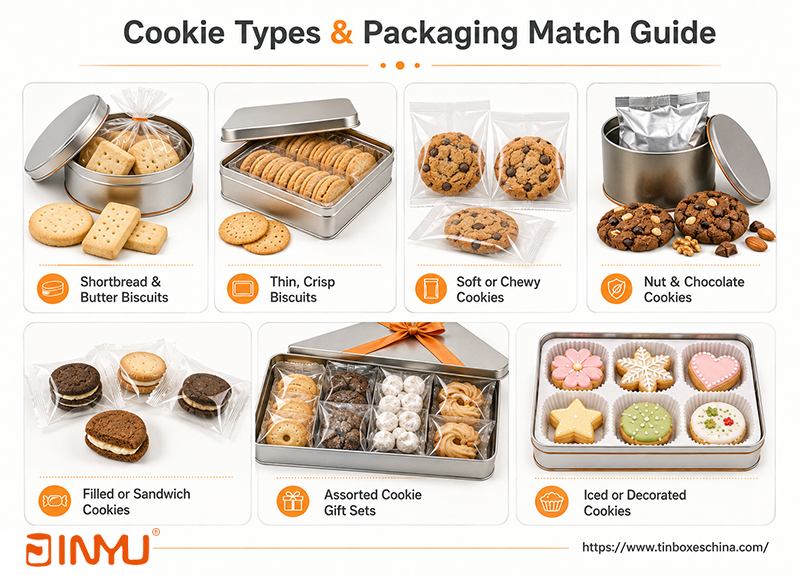
| Cookie type | Main freshness risk | Recommended packaging approach |
| Shortbread and butter biscuits | Moisture absorption and fat oxidation | Tin with a sealed inner bag or tightly closed liner |
| Thin, crisp biscuits | Loss of crunch and physical breakage | Shallow tin, high-barrier inner pack, and fitted tray |
| Soft or chewy cookies | Moisture loss and hardening | Individually sealed packs or a validated high-seal system |
| Nut and chocolate cookies | Oxidation and aroma loss | Opaque tin with oxygen-resistant inner packaging |
| Filled or sandwich cookies | Moisture migration between layers | Individually wrapped portions and controlled formulation |
| Assorted cookie gift sets | Cross-flavour and cross-moisture transfer | Separate sealed groups, mini pouches, or individual wraps |
| Iced or decorated cookies | Surface damage and breakage | Fitted tray, paper cups, and limited internal movement |
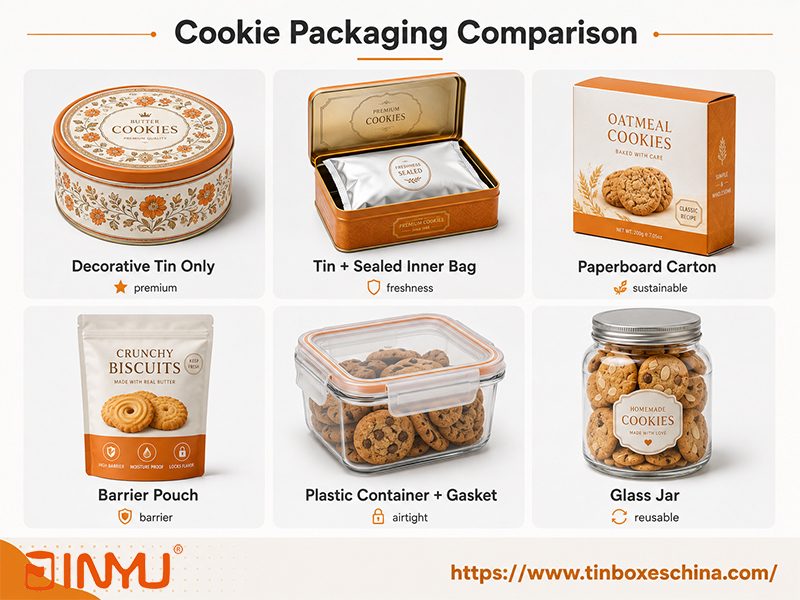
| Packaging format | Moisture and oxygen protection | Physical protection | Shelf presentation | Relative cost | Main limitation |
| Decorative tin only | Moderate; depends on lid fit | High | Premium, printable, reusable | Mid-to-premium | Usually not hermetically sealed |
| Tin with sealed inner bag | High when inner bag is correctly specified | High | Premium outer presentation | Mid-to-premium | More components and packing steps |
| Paperboard carton | Low to moderate without barrier liner | Moderate | Lightweight, large print area | Low-to-mid | Usually requires an inner bag |
| High-barrier flexible pouch | Potentially high when properly sealed | Low | Compact and economical | Low | Limited crush protection |
| Plastic container with gasket | Can be high depending on closure | Moderate to high | Functional, often transparent | Mid | Allows light exposure |
| Glass jar | Can provide strong closure | High but brittle | Visible, premium | High | Heavy, breakage risk |
As a general guide, a decorative tin with a sealed inner bag sits in the mid-to-premium cost range — higher than a standalone flexible pouch, but with significantly better crush protection and gift value than either a pouch or paperboard carton.
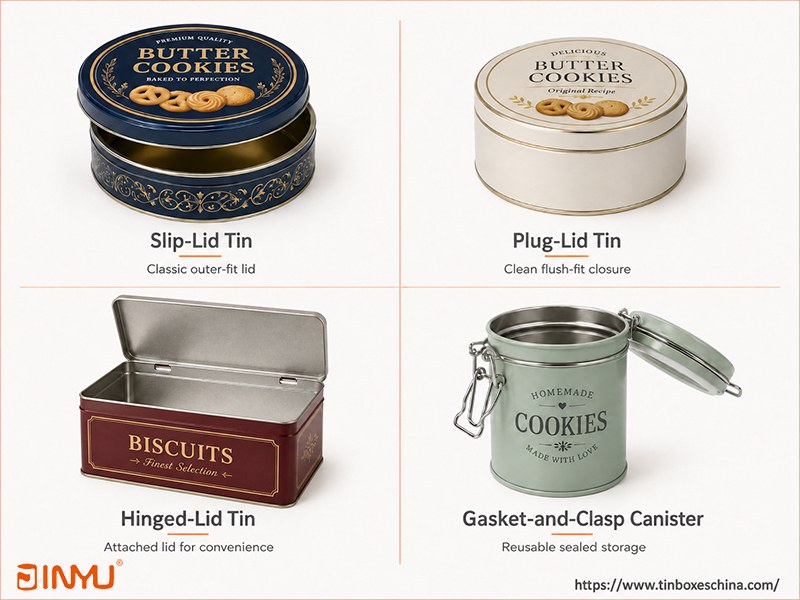
The lid affects convenience, repeat use, and how much outside air can enter the package.
A slip lid fits over the outside of the body. This is the most common structure for round, square, and rectangular biscuit tins. It is familiar, efficient to manufacture, and easy to decorate. Suitable for butter cookies, shortbread, holiday assortments, and any product with a sealed inner bag. The fit can be adjusted within practical manufacturing limits, but it should not be described as completely airtight without testing.
A plug lid includes an internal section that enters the tin body opening. This creates a cleaner body-to-lid profile and a more controlled closure. It may feel tighter than a basic slip lid, but final barrier performance still depends on the full closure system.
A hinged lid remains attached to the body. Convenient for individually wrapped biscuits, hotel selections, café counter products, and everyday pantry packs. The hinge improves convenience but does not automatically improve sealing performance.
This structure uses a gasket and mechanical clasp to apply pressure around the lid. It may provide stronger reclosure for reusable storage but introduces additional components, higher assembly cost, and more complex recycling separation. It is more common in reusable storage canisters than traditional flat biscuit gift tins.
Are decorative cookie tins airtight? Most standard decorative cookie tins are not hermetically airtight. A slip lid, plug lid, or hinged lid may close firmly and reduce air movement, but a small amount of exchange can still occur around the closure. On our production floor, we do not describe a decorative cookie tin as airtight simply because the lid feels tight. The complete pack must be evaluated under intended filling, transport, and storage conditions. Packaging research also shows that barrier performance should be evaluated at the complete-package level rather than from the packaging material alone, because seals and joining areas can contribute meaningfully to total oxygen and water-vapour transmission (Reinas et al., 2016). If your product requires a verified hermetic seal, a gasket-and-clasp structure or — more commonly — a high-barrier sealed inner pouch is the practical path.
The decorative tin is the part consumers see and keep, but the inner pack often performs most of the technical sealing work. Studies comparing multilayer packaging materials for biscuits have evaluated water-vapour and oxygen transmission together with changes in product moisture, water activity, texture, and lipid oxidation during storage (Romani et al., 2015).
A heat-sealed pouch can be selected for its resistance to water vapour, oxygen, aroma loss, grease, puncture, and seal failure. The outer tin then provides light protection, crush resistance, stable stacking, gift presentation, brand communication, convenient reclosure, and reuse value.
This combination is especially useful for seasonal biscuit gifts and products transported over long distances. For example, a brand may pack butter biscuits in a heat-sealed bag before placing the bag inside a printed Christmas tin. The inner bag supports the declared shelf life. The tin protects the bag, presents the product, and remains useful after the biscuits are finished.
When individual wrapping makes sense:
Several flavours share one tin
The product is consumed over a long period
Soft and crisp cookies are included together
Hygiene after opening is important
Portion control is required
Strong flavours need to remain separate
The additional material and packing cost should be factored in, but individual wrapping provides better control than relying on one shared atmosphere inside the tin.
This is one of the most common mistakes we see.
Two products weighing 500 grams may require very different containers. A thin wafer biscuit, a thick chocolate cookie, and a dense shortbread have different diameters, thicknesses, packing densities, fragility levels, and inner-pack dimensions.
We worked with a butter cookie brand whose 500g tin was originally sized for a denser product. Their cookies were light and voluminous — 500g filled barely 70% of the container. The extra headspace caused cookies to shift during transport, and breakage rates approached 8%. We suggested a shallower tin from our existing mould library with approximately 30% less internal volume. The same 500g of cookies filled it neatly with enough room for a sealed inner pouch. Breakage dropped below 1% in the next production run.
Problems caused by too much headspace:
More air inside the package
Greater movement during transport
Increased breakage
A less generous visual impression
Higher material and freight cost
Problems caused by too little space:
Cookie compression and edge breakage
Lid contact with the top layer
Slow manual packing
Difficulty fitting the inner bag
Inconsistent closing
Before confirming the mould, we ask clients to provide the cookie dimensions, number of pieces per tin, total net weight, number of layers, and any inner bag or tray requirements. Whenever possible, send physical cookies or dummy samples — a catalogue capacity number alone is not enough.
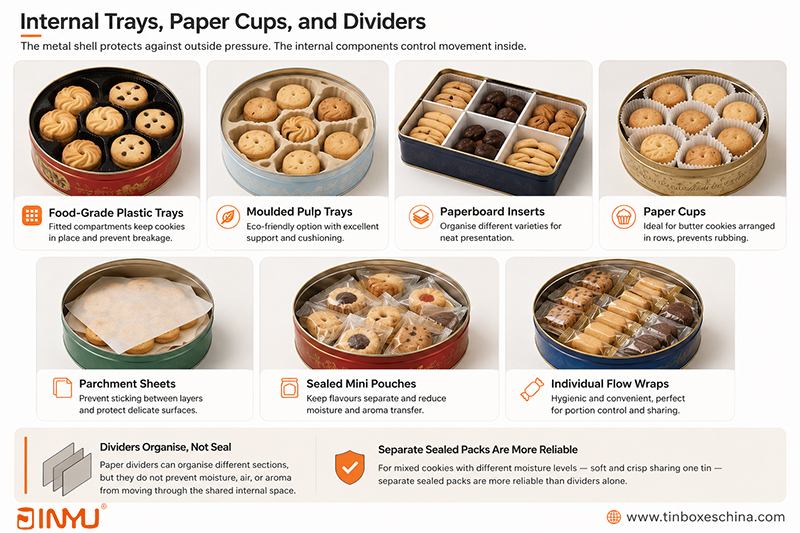
The metal shell protects against outside pressure. The internal components control movement inside.
Common options include food-grade plastic trays, moulded pulp trays, paperboard inserts, paper cups, parchment sheets, sealed mini pouches, and individual flow wraps. A fitted tray is useful when the product must remain in a fixed presentation. Paper cups work well for butter cookies arranged in rows. Parchment sheets help prevent sticking between layers.
Paper dividers can organise different sections, but they do not prevent moisture, air, or aroma from moving through the shared internal space. For mixed cookies with different moisture levels — soft and crisp sharing one tin — separate sealed packs are more reliable than dividers alone.
Even a well-designed tin cannot correct problems created before the lid goes on.
Cookies should be sufficiently cooled before packing. Warm products release water vapour, which can condense on the inside of the tin or inner bag. Condensation may cause softened biscuits, surface spotting, sticking, coating damage, and — under unsuitable conditions — mould risk.
A client once asked us why their shortbread developed a soft, stale texture within three weeks of packing — despite using a well-fitted tin with a sealed inner bag. After reviewing their process, we found the cookies were being packed at roughly 35°C, still warm from their cooling rack. Residual heat created condensation inside the sealed pouch. Once they extended cooling time by 45 minutes and confirmed the cookies were below 25°C at filling, the issue disappeared. The tin and inner bag were never the problem.
Commercial packers should confirm product temperature at filling, cooling time, room humidity, water activity, time between baking and sealing, and seal integrity. The tin should also be clean and dry before filling.
When cookies or their liners contact the metal interior, the complete food-contact system should be suitable for the intended use.
This may include the tinplate substrate, internal lacquer, printing ink location, paper liner, plastic tray, adhesive, inner pouch, gasket, and sealing material. The appropriate specification depends on whether the cookie directly contacts the tin, fat and oil content, product acidity, storage duration and temperature, and destination market regulations.
Printing is normally applied to the exterior surface. Where inside printing or decoration is requested, its position and suitability should be reviewed carefully. A general statement such as "food-grade tinplate" is not enough to define the safety of every finished package. Brands should request relevant material declarations and test documentation from the packaging supplier for the complete combination of materials in their specific product. Research on steel food-packaging systems has examined how the performance of internal lacquer depends on the substrate, coating chemistry, and exposure conditions (Allman et al., 2018). Migration studies on polyester can coatings further demonstrate that food-contact assessment needs to consider the coating system and intended contact and storage conditions, rather than the metal substrate alone (Paseiro-Cerrato et al., 2016).
Storage conditions after packing:
Cookie tins should normally be stored in a cool, dry environment. Avoid direct sunlight, high humidity, heat sources, rapid temperature changes, and proximity to strong-smelling products. The opaque tin protects the product from light, but heat can still transfer through the metal. Retailers and distributors should also maintain suitable conditions — a technically sound package cannot guarantee product quality if exposed to extreme heat or moisture for long periods.
Test the complete pack before production:
Shelf-life performance cannot be predicted from an empty tin sample. Testing should include the actual cookie, the final inner packaging, a production-representative tin, the real filling quantity, the intended tray or divider, the final closing method, and expected storage conditions. An empty sample can confirm dimensions, printing, finish, and lid feel. It cannot prove how long the cookies will stay fresh. The final shelf-life claim should be supported by testing of the complete commercial package.
Common mistakes we see:
Calling every tin airtight: A tight-feeling lid does not prove hermetic sealing. Use accurate wording such as "tight-fitting," "reclosable," or "designed to reduce air exchange" unless performance has been tested.
Selecting the tin by weight alone: Net weight does not show cookie volume, arrangement, or fragility. Confirm real product dimensions.
Packing warm cookies: Residual heat creates moisture inside the package. Confirm cooling conditions before sealing.
Mixing soft and crisp cookies in one open space: Moisture migrates between them. Use separate sealed packs.
Relying on paper dividers for freshness separation: Dividers organise contents but do not create separate sealed environments.
Ignoring the inner bag: For a long commercial shelf life, the inner bag may provide more moisture and oxygen protection than the decorative tin.
Leaving too much empty space: Large internal gaps increase movement and breakage. We've seen breakage rates drop from 8% to under 1% purely by right-sizing the tin to the product.
Approving artwork before confirming the structure: The hinge, lid curl, side seam, rounded corners, and forming areas can distort important graphics. Confirm the mould and structure before finalising artwork.
Yes. Cookie tins help keep cookies fresh by blocking light, limiting exposure to outside air and humidity, reducing aroma loss, and protecting the product from crushing. However, the final result depends on the lid, cookie formulation, inner packaging, and storage conditions.
Most standard decorative cookie tins are not hermetically airtight. A snug lid reduces air exchange, while a gasket, sealed liner, or high-barrier inner bag can provide stronger protection.
For commercial products with a defined shelf life, an inner bag is often recommended. The inner bag provides the primary moisture and oxygen barrier, while the tin provides structural, light, and presentation protection.
There is no universal answer. Shelf life depends on the cookie type, initial moisture and water activity, fat content, inner packaging, lid structure, storage temperature, humidity, opening frequency, and filling hygiene. The declared shelf life should be based on testing of the actual product and final package.
They should not share an open internal atmosphere for long periods. Moisture migrates from softer cookies to crisp biscuits. Separate sealed packs or individual wrapping are more reliable than paper dividers alone.
Parchment paper helps prevent sticking, surface damage, and direct contact between layers. It is not a high-barrier moisture or oxygen seal.
The rigid metal body improves crush protection, but correct sizing and internal support are still required. Trays, paper cups, liners, and limited headspace help prevent movement and impact inside the tin.
A window can improve product visibility, but it reduces the fully opaque light barrier. It is generally better suited to individually wrapped biscuits or products whose shelf life has been tested in the final window-tin structure.
No. We occasionally hear this question from small bakeries transitioning to commercial packaging. Adding bread is a household storage method, not a controlled commercial packaging solution. It introduces additional moisture, allergens, odours, and microbiological variables.
Only a food-contact-compliant desiccant that is suitable for the actual product and validated in the final packaging system should be considered. Desiccants intended for shoes, electronics, or non-food products must not be placed in food packaging.
A successful cookie tin project starts with the biscuit — not the artwork alone.
To evaluate the correct tin size, lid structure, and internal packaging, prepare the following:
Cookie type and individual dimensions
Number of cookies per tin and net weight
Required shelf life
Current inner bag or flow-wrap format
Preferred arrangement and tray or divider requirements
Destination market
Estimated order quantity and number of printed designs
Reference artwork or existing packaging samples
Jinyu supports custom cookie tin projects through existing-mould selection, structural development, tinplate printing, colour matching, embossing, internal trays, sample production, quality inspection, and export packing.
Send us your biscuit specifications and a rough order quantity. We'll suggest the closest matching tin structure from our existing mould library, discuss inner-pack compatibility, and prepare a digital mockup — typically within 48 hours. Once the structure is confirmed, we'll guide you through artwork preparation, finish selection, and sampling.
The following peer-reviewed studies provide additional scientific background for the discussion of biscuit moisture, texture, oxidation, packaging barriers, seal performance, and food-contact coatings in this guide.
Obtenez les dernières informations et offres spéciales


 Réseau IPv6 pris en charge
 Français
 English
 Deutsch
 Español
 Português