
A tobacco tin can be a shallow hinged box, a tall flip-top case, and a round sealed can. They need different loading, protection of product, opening and storage.
The contents and the job the pack has to do is the start of choosing tobacco tin packaging. Cigarets, cigarillos, larger cigars and loose tobacco each require different internal configurations. Then, the closure, insert and sealing method must work in conjunction with the packaging specifications of the target market.
Hinged, sliding and lift-off tins provide different ways of accessing the product, whereas ordinary versions do not offer an airtight seal or a validated shelf life.
Inserts hold a single cigaret or cigar. Designated inner pouches and sealing systems may provide additional barriers to moisture exchange.
Vacuum packing tins and easy open cans require compatible components and controlled packing processes, and their original seals are not restored by simply replacing a lid.
Capacity is based on usable internal dimensions, actual product size, packing orientation, and any inserts, wrapping or sealing components included.
Confirm sales market, packaging role, filling method and acceptance criteria before ordering and approve a representative filled sample.
Indicate whether the project is a retail pack with tobacco, an outer pack around an existing pack or an empty reusable case. These roles impact both development and requirements that apply.
Regulation 4 of the UK’s Standardised Packaging of Tobacco Products Regulations 2015 specifies carton or soft material for cigaret unit packets, a cuboid shape and a minimum of 20 cigarets. These current requirements are also summarised in the government’s 2026 packaging consultation. A metal case which physically fits cigarets cannot therefore be automatically the retail unit pack for them in that market.
Before committing to any tooling or artwork, check for any applicable requirements. An extra outer tin does not automatically mean packaging duties are discharged.
The product description needs to be precise as well. Identify cigarets, cigarillos, larger cigars, pipe tobacco or rolling tobacco instead of just “tobacco” • For loose products, mention the cut and intended packing condition. In its overview of pipe tobacco, the Scandinavian Tobacco Group differentiates formats like flake, loose cut and ready rubbed, and notes that both pouches and tins are used as packaging to retain moisture.
Three design choices: how the lid opens, how the contents are arranged, and where the seal is made.
A hinged format with a different loading direction is an upright flip-top case. The round can may contain loose tobacco or upright sticks. Several styles of closures allow an insert to be added.
Practical combinations are listed in the following table. Suitability of the combinations is determined by product and sample review.
| Format. | Applications for testing | Functionality strength | Main limitation or check |
| Flat tin hinged | Cigarets or cigarillos in rows; tobacco in a separate inner pack | Wide access and attached lid | Play inside and outside, hinge clearance, closure retention |
| Standard tin take-off | Loose tobacco suitable inner pack Flat or upright arrangements | Open Base, Access from All Sides | Limitations on lid separation, fit, consistency and sealing |
| Tin, sliding lid | Shallow bunches of single sticks | Partial opening without lifting the cover | Slide clearance, wear, stops & product contact. |
| Flip-top tin upright | cigarets in vertical stacks or cigarillos of appropriate size | Top opening access | Removal space, clearance for remaining product, clearance for lid |
| Vacuum sealable tin | Tobacco which has to be in a particular factory sealed pack | Sealing interface dedicated | Compatible sealing compound, equipment, process control |
| Easy open or peelable seal can | Tobacco requiring a single-time opening seal | First defined system opening | Seal integrity. Opening edge and independent reclosing devices |
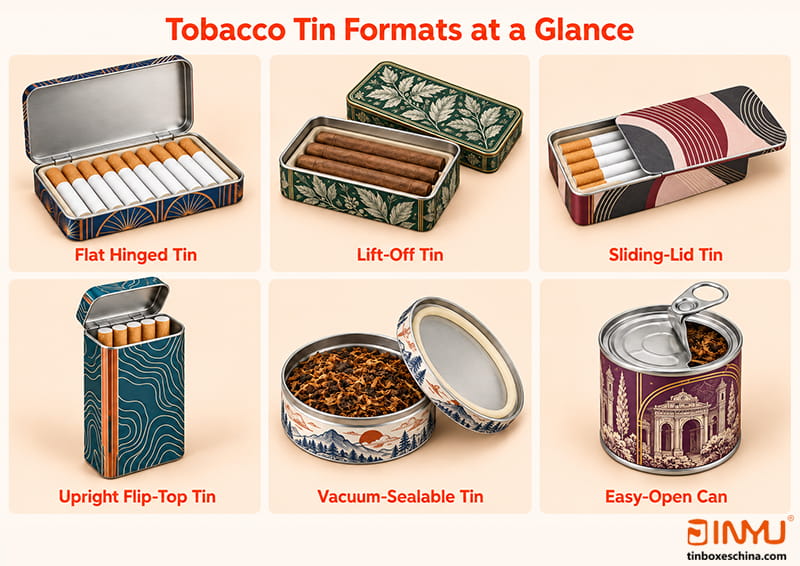
The tin has a hinge so the lid is connected to the body of the tin. The wide opening allows for loading and inspection of the products in rows with the hinge along the selected edge.
The interior may contain a fitted tray, folded liner or other agreed arrangement. Compartments are optional. Depending on the movement of the product, surface sensitivity and presentation.
During sampling, verify that the hinge does not protrude into the cavity and check for clearance between the lid and the tallest packed item. Open and close the loaded box and check the products nearest the hinge and front rim. The outer shape may match the amount desired, but it may need a different insert, or more depth.
A lift off lid separates completely from the base. This format can be developed in the form of shallow rectangular box, square tin or deeper round container.
The open base can be approached from different angles, which may help in placing trays or loading an inner pack. The separate cover also introduces a handling step during assembly.
Define lid overlap and acceptable fit. A cover should fit evenly without compression that would distort the pack or disturb its contents. Normal friction fit alone is not enough to prove your airtight claim.
A sliding tobacco tin is opened by sliding the lid along the formed edges or guides. The layout must not block the full sliding path.
Look at the top of the contents including wrappers, labels and walls of the tray. A filled pack, clearing an empty insert, may rub against a lid.
Verify that the lid stops at the end of its travel, that it cannot detach and how its movement changes after repeated opening. For a pocket-sized case, evaluate also accidental movement during normal handling. The smooth sliding action and the secure retention have to be evaluated together.
A standing cigaret or cigarillo tin holds the sticks vertically, with access through a top opening. Tell us the usable depth, the width of the opening and the amount of product exposed for gripping.
Test the pack when it’s full and when there’s just a few pieces left. The other pieces may be able to tilt or move under the opening. A full set may be self-supporting.
When closing the lid must clear product ends. Any internal shoulder, retaining feature or liner should be able to support the arrangement without scraping the contents. This format requires a sample review of its own, not a rotation of a flat-box layout.
Vacuum packaging is dependent on the designed seal interface and controlled packing process. Nor will a close-fitting metallic lid.
Pirlo's tobacco tins official technical sheet mentions vacuum tins, screw vacuum tins and a rounded-square vacuum version. It says that a compound added to the lid assists in the formation and retention of hoover.
Ask supplier to specify : construction of closure, sealing material, compatible equipment, any checks required after packing. Confirm which party provides the components and which party builds the finished seal.
Opening the bag and putting the lid back does not replicate the original vacuum-packing. Reclosures should be evaluated on a case-by-case basis.
A ring-pull tobacco can has a one-use opening panel. Alternatively, a flexible peelable membrane, even if it also has a pull tab.
Crown's PeelSeam technology is a flexible foil sealed to a rigid steel ring with a heat seal, which can then be double-seamed to a suitable container. This is an explanation of a closure mechanism, and not a proof of suitability for all tobacco products.
Show a picture of the whole can, the bottom included Agree on the filling route, final sealing operation and equipment requirements. If repeated access is needed, use an overcap or other reclosure and test its performance after the original seal has been broken.
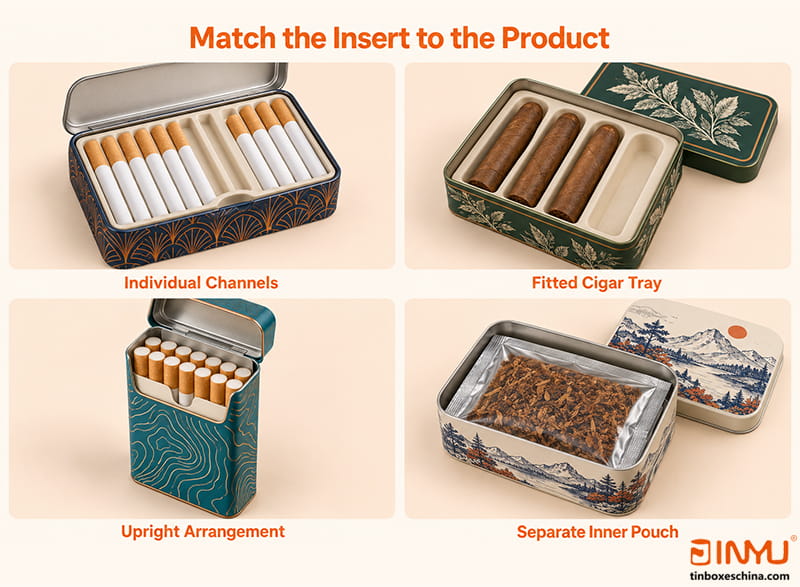
The insert positions the contents . Exchange with the surrounding environment is regulated by a sealing layer. Some assemblies combine these functions, but each function requires its own specification.
| Internal Section | Primary role | Detail to specify |
| Tray with separate channels | Position and sticks separately | Channel profile, depth, spacing, gripping access and materials |
| Paperboard separator, folded | Supports rows or sections | Assembly and fit, board grade, edge contact |
| Paper liner | Separates contact surfaces and helps in handling | Material, folds and interaction with the content |
| Inner bag sealed | Provides a separately identified barrier pack | Barrier construction Seal quality Filled dimensions Contact layer |
| Sealing compound or gasket for lid | Works with the sealing surface of the lid | Material, Geometry, Compression, and Process Requirements |
| Humidity-control element | Is part of a validated storage system | Product compatibility, space, separation and operational conditions |
Include bands, individual wrappers and variance in the finished cigar dimensions for cigar tins with inserts. The pocket should cradle the product without gripping delicate surfaces too hard.
Flat arrangements require the availability of center and end positions. Upright arrangements need to have sufficient exposed length to grip a piece without pulling against its neighbours.
A multi-layer pack must also have a defined method for lifting or separating layers. Once transport simulation is loaded and open, check the bottom layer, it might be different from the visible top layer.
Evaluate a direct-fill and an inner-pouch system as distinct loose tobacco configurations. The sealed ends, the folded and filled thickness of the pouch all occupy space in the tin.
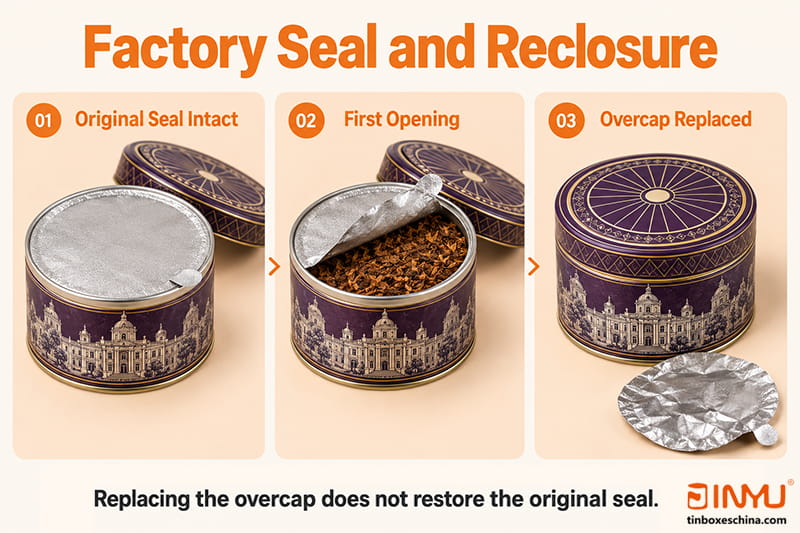
Moisture protection is the management of moisture loss and moisture gain under expected conditions. But a metal body doesn't tell you how its lid, seams, liner or pouch will perform.
Crown’s seaming guidance describes the two-step process for joining the can end and body edges in double-seamed cans, with gasket material filling in the gaps inside the seam. The hermetic seal is directly related to the complete seam and its formation.
Evaluate the package in the 3 states:
| Package status | What question is being asked? | Evidence to seek or create |
| After filling, unopened, | Is the finished pack in the agreed product condition? | Assessment of seal checks and storage under defined conditions |
| First published | Can I open the pack and use it as it was meant to be used? | Trials at opening, edge inspection and product disturbance observation |
| Reclosed in employment | What protection is left when the original seal is broken? | Repeated use evaluation of the proposed cover or pouch closure |
A metal overcap will fit over an opened can, but it doesn’t reproduce the original factory seal. Also, the resealable pouch zipper should be evaluated independent of the first heat seal.
For cigars, differentiate between a carrying case and a humidity-controlled storage system. VILLIGER’s official cigar dictionary distinguishes cigar cases from humidors and discusses the limitations of cases for long-term storage. So a normal tin should not be called a humidor just because it has a lid or insert.
Use the product owner’s storage specification to determine the packaging brief. Do not apply one humidity target or shelf-life claim to all cigarets, cigarillos, cigars and tobacco blends.
Outside dimensions are helpful in planning cartons. The product must fit inside the usable cavity, taking into consideration rolled edges, hinge parts, lid overlap, inserts and inner packaging.
For individual sticks state actual length and maximum diameter as intended in packed condition. Include wrappers and any raised band/label. Please confirm number of rows, number of layers and orientation.
The volume of pipe tobacco tins is not determined solely by the net weight. A loose cut and a pressed flake can take up different volumes at the same weight. Fill with a representative fill prepared by the method of packing intended.
| Measurement: | What it does establish is |
| Normal variation and product dimensions | Required length, width and clearance |
| Insert thickness & cavity depth | Space used above and below the contents |
| Internal blockages | Space Lost to Hinges, Shoulders, and Rolled Edges |
| Full fill height | Clearance with lid fully seated |
| Pouch folds and/or sealing means | More room than tobacco. |
| Moving expenses | Space for product, insert or inner pack |
Sample filled capacity is approved. If the specification changes (from unwrapped to individually wrapped products) re-assess the fit before using the same tin and insert.
Identify the metal, instead of using the word “tin.” Material specification for a tinplate project should identify the steel sheet, coating system and thickness appropriate to the selected construction.
Thickness must work with box dimensions, formed features and expected handling. It is part of the structure design together with the rim, lid and base construction.
List all components that could contact the product: internal coating, liner, tray, adhesive, sealing material. Check the final assembly if you want the desired contents. Ask for the materials respective information. A generic statement of food-contact suitability is not sufficient to establish suitability for all tobacco applications.
Look for coating damage, exposed edges, loose particles and a noticeable packaging odour during sample review. Any necessary transfer or compatibility testing should be performed with agreed methods and acceptance criteria.
Artwork needs a functional layout as well. Reserve the required warning, identification, tax-mark and traceability areas for the market intended. Ensure that critical information is free of lid overlap, hinges and opening features. Get the brand’s approval before printing.
Packaging applications can be documented for official brand materials. They rarely provide enough data to specify the complete procurement specification.
| Source or brand | Fact-Checked Packaging | Lesson in procurement |
| Signature – Scandinavian Tobacco Group (STG) | Page 27 of 2021 annual report shows a shallow hinged tin with cigarillos lined up side by side | The wide opening and row arrangement can be evaluated together, but the photograph doesn't show the seal performance |
| VILLIGER: MINI | Metal cases for the line-up are available on the official MINI COLORLINE page | Cigarillo is a known application for metal packaging, but the exact closure and internal specification are yet to be confirmed |
| Diehl, Cornell & Co. | The official company website describes the packaging, sealing and labelling of its bagged and tinned products | The tin sourcing process should include the filling, sealing and labelling workflow, not just the empty container |
These are examples of public packaging, not brand buys. The procurement lessons are structural readings . The Signature image is an example of historical packaging and packaging may vary by market and date.

Use samples representative of the proposed metal, coating, insert and closure . While a blank outer tin can confirm the preliminary dimensions, it can’t approve the whole packaging system.
Test conditions and acceptance criteria prior to testing agree sample quantity.
| Check it out | Proposed evaluation | Statistics |
| Loading... | Insert target content in the desired sequence | Access problems, loading time and components to be checked |
| Fit for product | Check all positions and relevant product-size variation | Movement, marks of pressure, scraping, wiping |
| Open-and-shut | Run the loaded closure through mutually agreed cycles | Binding, loosening, separation, or contact with the contents |
| Partly empty packet | Repeat access with fewer remaining parts | Loss of support, inaccessible pieces and tilting |
| Seal performance | Use a method suitable for the sealing system in question | Results, equipment settings, detected defects |
| Storage | Evaluate the filled pack in agreed conditions | Product moisture or other agreed quality indicators, method and timing |
| Distribution and release | Check the loaded tin with its shipping protection intended for it | Dents, opening, insert, movement and damage of product |
| Printing and marking | Check the pack you’ve assembled. | Readability, placement, abrasion and accessibility of required markings |
A fit check is done to see if the contents can be packed and unpacked. Evidence that matches is required for storage claims.
Find sample versions. Log drawing revision, component specification, date of fill, and changes between trials. If tray/gasket/pouch changes since approval, re-evaluate affected functions.
The lowest empty tin price may refer to a different package than the one you need.
Separate costings for the tin body & lid, inserts, sealing components, tooling, decoration, assembly and transit protection. Note any minimum quantities for specialist parts.
Even a standard outer mould may need a new tray tool. Equipment setup or format parts at the filling facility may also be needed for a sealed-can project. Include when comparing total project cost:
Check supply condition (fitted or separate lids, fitted or loose inserts, supplied cans with a specific end fitted, components protected for transport).
Take responsibility for the final seal. The empty-packaging supplier and the tobacco filling facility have different operations and the approval plan should specify who controls and records each.
A good RFQ for tobacco tin packaging will allow the supplier to evaluate the entire pack.
| Information to be supplied | What the supplier needs to know |
| Product group and sales countries | 4.3.2. Packaging requirements 4.3.2.1. Intended use and packaging requirements |
| Packaging role | Retail unit, outer container, or empty reusable case |
| Samples or dimensions of products | True size, variation, wrappers and surface sensitivity |
| Target quantity or Net weight | Ability to validate by sample packing |
| Preferred layout | Single layer, multi-layer or loose fill, flat or upright |
| Closing and sealing requirement | Gasketed closure Regular cover Single use seal or hoover system |
| Interior components | Tray, liner, pouch and other defined components |
| Filling process | Loading of available equipment manually or automatically, and the obligation to seal |
| Storage and distribution short brief | Conditions and duration of protection after opening proposed |
| Areas of artwork and marking | Approved decoration and necessary information |
| Quantity and timing | Order Volume repeat demand sampling delivery timing |
Photographs of what you want to do but do give measurements too. A picture might show the layout but omit important dimensions and sealing details.
Normal versions are not assumed to be watertight. Any such claim requires evidence for the particular closure and full pack. A separate validated inner pack can be used to obtain a different barrier arrangement.
Nope. Inserts are selected for fit, movement, surface protection and access. Other arrangements use liners or wrapped groupings. Test the selected configuration on the real products.
It can be assessed for that arrangement. Check for usable depth, opening access and movement as the pack drains. Just because it is physically fit, does not mean it is eligible to be used as retail packaging in a given market.
No, not at all. A ring pull is an opening feature. Vacuum packing is a different process and seal performance depends on the whole can and its sealing operation.
A typical tin does not in itself provide a controlled humidity. Any storage system that claims that function needs the proper components and validation for the cigars it is intended to store.
Maybe, but each fill is to be reviewed. Space needed is influenced by cut, packing condition, headspace and inner packaging. Test each configuration on a representative sample.

Obtenez les dernières informations et offres spéciales


 Réseau IPv6 pris en charge
 Français
 English
 Deutsch
 Español
 Português