
Selecting a tea tin is not simply a case of buying a round or square metal box.
The lid structure determines how often the package can be opened, how much outside air and moisture it restricts, and how the tea is filled. The shape affects shelf presentation, carton efficiency, and available printing space. The tea itself dictates the required capacity, opening size, and primary barrier.
This guide draws on our experience at Jinyu producing tea tins for brands, importers, packaging distributors, and private-label buyers. We've included the structural choices, the practical checks we run on our own samples, and the mistakes we see most often — so you can match the right tin to your product without costly trial and error.
Dry tea is sensitive to light, heat, moisture, oxygen, and surrounding odors. The metal body blocks light effectively, but protection from air and humidity depends on the lid, the seams, and any inner packaging used with the tin.
Packaging requirements also vary by tea type:
Fresh green tea, matcha, and aromatic loose-leaf blends need strong protection because they are opened repeatedly.
Individually wrapped tea bags already have a primary wrapper, so the outer tin can prioritize convenience and presentation.
Dark teas that are deliberately aged may require a different storage strategy altogether and should not automatically be packed with the same assumptions as fresh green tea.
When we work with clients, the first question we ask is not "what shape do you want?" but "what is the tea, how will it be filled, and where will it be sold?" That question determines everything that follows.
| Tea tin type | Closure and protection potential | Best suited to | Main procurement consideration |
| Single slip-lid tin | Basic friction-fit closure | Tea bags, fast-moving loose tea, promotional packs | Should not be assumed airtight |
| Plug-lid tea tin | Lid section fits into the body opening | Everyday loose leaf tea, modern retail packaging | Plug depth and fit affect opening resistance |
| Double-lid tea caddy | Inner lid plus outer cover | Premium loose leaf tea, aroma-sensitive blends | More components, filling steps, and cost |
| Hinged-lid tin | Lid remains attached to the body | Tea bags, sachets, sampler packs | Convenient, but normally not the strongest moisture barrier |
| Screw-top tea tin | Threaded rotating closure | Matcha, powdered tea, refillable canisters | Thread quality and liner design must be consistent |
| Gasket-and-clasp canister | Mechanical clamp compresses a gasket | Premium reusable storage, larger loose leaf packs | Gasket material, compression, and replacement life |
| Sealed matcha tin | Primary membrane or easy-open seal plus outer lid | Matcha, sensitive powdered tea | Strong unopened barrier; reclosure matters after opening |
| Square or rectangular tin | Available with several lid systems | Tea bags, boxed blends, space-efficient retail ranges | Corners, carton packing, and body rigidity |
| Stackable multi-tier tin | Several separate tins connect vertically | Multi-flavor tea gifts, travel sets | Each compartment needs its own closure |
| Compartment or sampler tin | One outer tin holds divided products | Tea bags, sachets, premium gift assortments | Divider layout and product identification |
None of these descriptions should be treated as a definitive airtight classification. Seal performance depends on dimensional tolerance, lid design, gasket compression, seams, repeated use, and physical testing of the complete package. We always recommend testing with your actual tea, not relying on the tin type name alone.
This is one of the most common mistakes we see, so we're putting it up front. Tea density varies significantly.
100 grams of tightly rolled oolong occupies a very different volume from 100 grams of large twisted black tea, bulky white tea, or blends with fruit pieces and flowers. We've had a client order a tin labeled "100g capacity" for their white tea, only to find that 100g of their actual product overflowed the tin by nearly 30 percent.
The process we recommend:
Confirm your target net weight.
Obtain the real tea or a representative sample.
Measure the filled volume without over-compressing.
Allow space for the inner bag, liner, or scoop.
Check how easily the customer can access the tea.
Approve the final size on a physical sample.
Choosing a tin based on a catalog capacity number alone can leave you with an under-filled package that looks disappointing on shelf, or a lid pressed against the leaves.
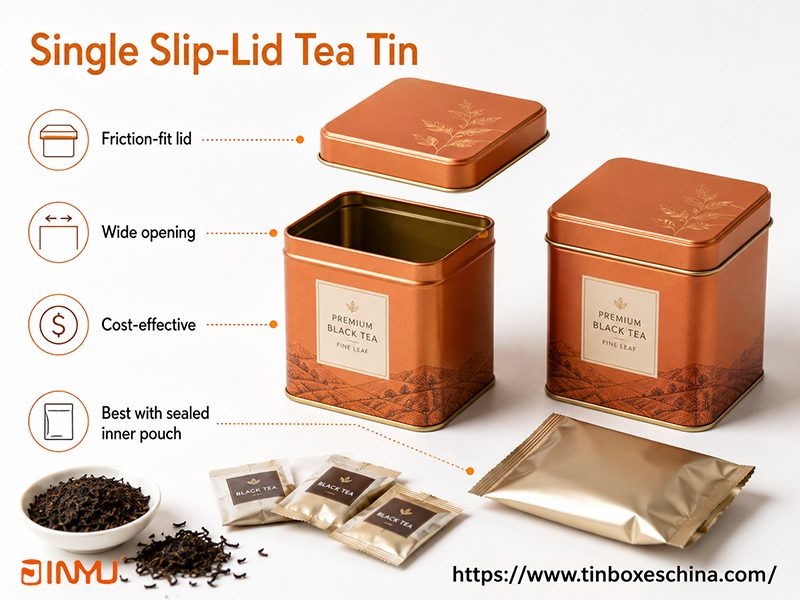
A slip lid covers the outside of the tin body and is held in place by friction. It remains one of the most common and economical tea tin constructions.
The lid lifts off completely, giving a wide opening for filling, scooping, or removing tea bags. Slip-lid tins are available in round, square, and rectangular formats from existing molds.
This structure works well for:
Individually wrapped tea bags
Fast-moving loose leaf tea
Promotional tea packaging
Seasonal products
Tea packed in a sealed inner pouch
What we've learned about slip-lid fit:
The seal is the limiting factor. The lid must be loose enough for customers to remove comfortably, but tight enough to stay in place during handling and transport. We aim for a pull-off force of 2–3 kg, measured with a force gauge on at least 20 random samples per batch. On one project for a UK tea brand, initial samples were too tight — customers complained. We adjusted the lid diameter tolerance to ±0.15 mm and reduced the body bead height by 0.3 mm. The result opened smoothly while staying secure.
If your tea is in a sealed primary bag, the metal package mainly provides light protection, physical durability, and shelf presence. In that case, a slip-lid tin is often the most practical and cost-effective solution.
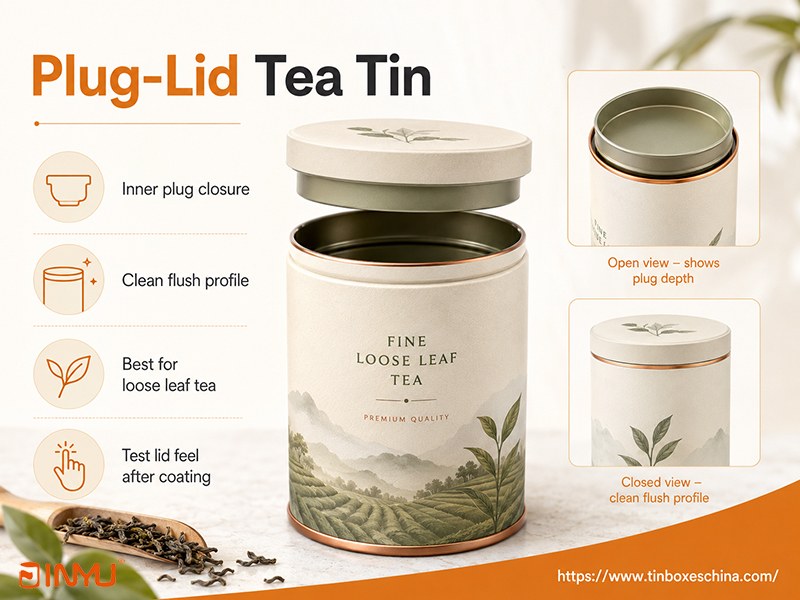
The plug lid has an inner section that enters the body opening when closed. In many designs, this allows the outer surface of the lid to sit flush with or close to the body profile, giving a clean modern appearance without an external hinge or clasp.
It works well for round, square, and rectangular retail tins.
Typical applications:
Green tea
Black tea
Herbal blends
Blooming tea
Loose leaf gift items
Tea powder in an inner bag
Plug depth matters more than most buyers expect:
We recommend a minimum plug depth of 8 mm for round tins under 80 mm diameter, and 12 mm for larger formats. A shallow plug may only partially engage, making the lid feel loose. A plug that is too deep or too tight can be frustrating to remove.
Buyers should test the lid feel after printing and forming — not just from a drawing. We've seen cases where the same plug depth felt different after the matte coating was applied, because the coating added a fraction of a millimeter to the contact surface. Always approve opening feel on a physical production sample, and test it after at least 30 open-close cycles to simulate real use.
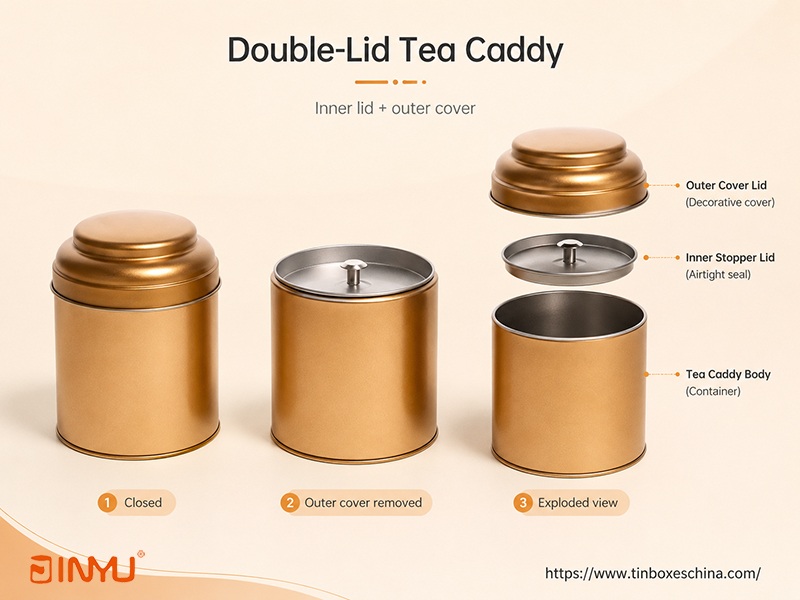
A double-lid tin has an inner lid and a separate outer cover. The inner lid limits direct exposure when the outer cover is removed, and the second lid provides an additional physical barrier.
This style is strongly associated with premium loose leaf tea and traditional tea caddies.
Especially appropriate for:
High-quality green tea
Black tea
Oolong tea
White tea
Scented loose leaf blends
High-value tea gift programs
Our production experience with inner lids:
The inner lid may have a small pull tab, a finger recess, or a raised handle. We aim for an inner lid removal force of 1.5–2.5 kg with a finger recess at least 3 mm deep. On one project, the recess was machined too shallow — under 2 mm — and even at 2 kg pull force, users couldn't get enough grip. The inner lid had to be pried off with a tool, which damaged the rim finish. We deepened the recess to 3.5 mm and the issue disappeared.
Double-lid tins provide more protection than a single decorative lid, but "double lid" is not a certified airtight standard. Actual performance depends on lid fit, seams, manufacturing tolerances, and whether a sealed inner bag is also used. Buyers should also factor in the additional component cost, the extra filling step, and the consumer's willingness to open two lids every time.
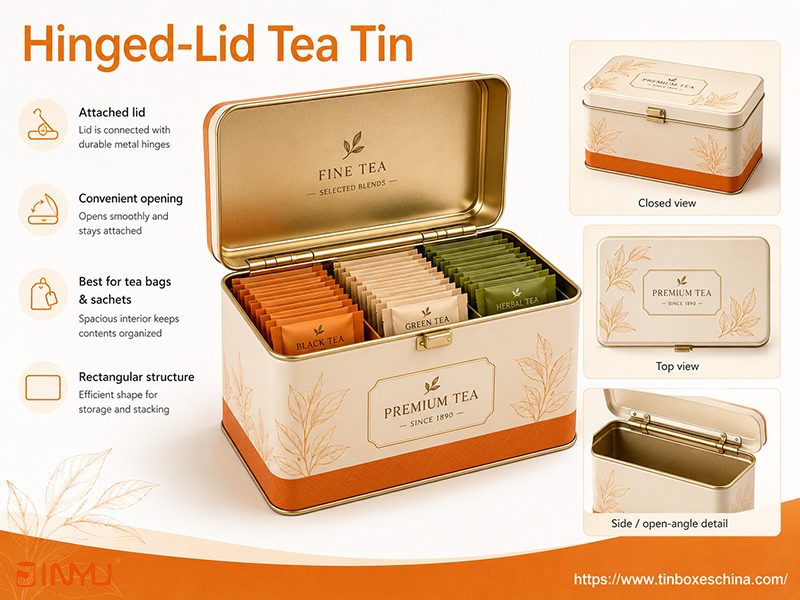
The hinged lid opens but stays attached to the body. This is especially useful when the contents will be accessed frequently and the customer doesn't want a separate lid on the counter.
Common formats we produce:
Tea bags
Individually wrapped sachets
Tea tasters
Small herbal tea collections
Hotel and hospitality products
Promotional tea gifts
This structure works particularly well with rectangular tins, where the long rear edge provides a natural mounting surface for the hinge.
What to check during sampling:
Hinge alignment, opening angle, and front closure. If the alignment is off, the lid may twist, rub against the body, or fail to close evenly. We check hinge function on 50 open-close cycles across 10 random samples before approving any hinged tin for production.
A hinged tin provides an excellent balance of convenience and presentation for individually wrapped tea bags. For unwrapped loose leaf tea, we usually recommend an additional sealed inner bag, because a standard hinge does not provide a continuous moisture barrier.
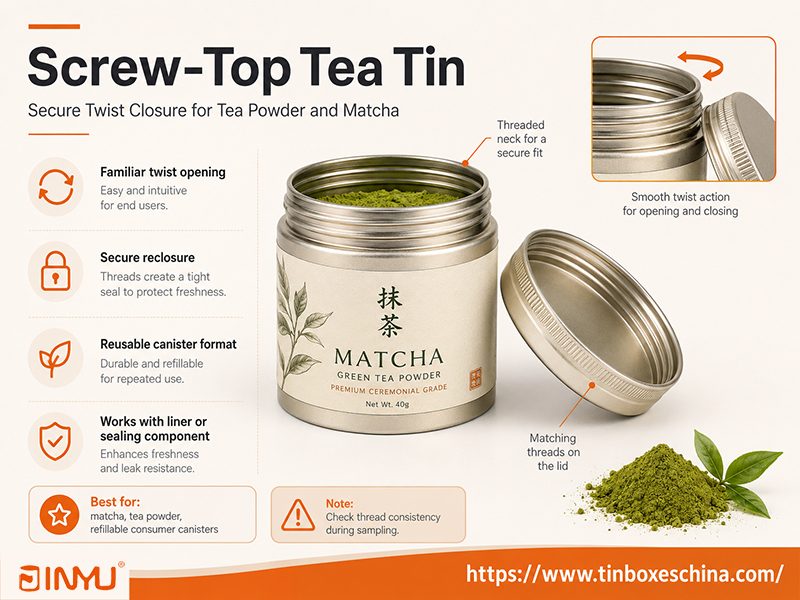
A screw-top tin closes by twisting the lid onto a threaded or formed neck. It's often associated with matcha, tea powder, and reusable consumer canisters.
Benefits include:
Familiar opening action
Controlled, sequential closure
No removable inner lid to lose
Compact round shape
Possible compatibility with a liner or sealing component
The risk we watch most closely: thread consistency
The quality of a screw-top tin depends entirely on how consistent the threads are between lid and body. If stamping tolerances vary, the lid may cross-thread, feel too loose, or require too much force. We sampled one matcha tin project where the lid cross-threaded on roughly 1 in 15 openings because the stamped thread pitch varied slightly between the lid and body tooling. We now recommend at least 50 open-close cycles on 20 random samples before approving bulk production. Any binding or loosening that appears during that test will show up at scale.
For powdered products, make sure there is enough internal clearance to prevent powder from accumulating in the thread area and affecting closure. A screw-top mechanism offers good reclosure, but the actual barrier performance still depends on the overall construction and any liner inside the lid.
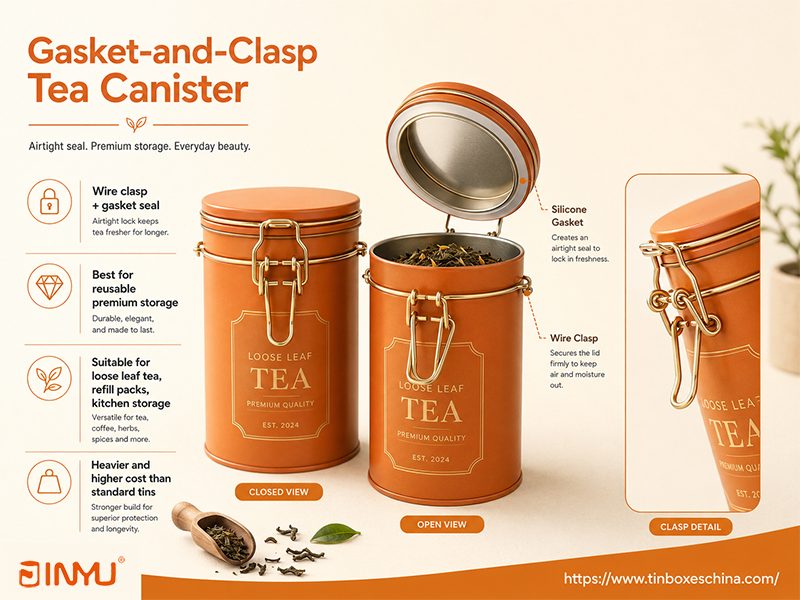
This style uses a hinged wire clasp or locking mechanism that compresses a silicone or rubber gasket between the lid and the body.
It is typically chosen for reusable premium storage, not lightweight promotional packaging.
Appropriate applications:
Larger loose leaf tea packs
Refill programs
Kitchen storage jars
Tea shop display and storage
Reusable gift sets built to last
A well-designed gasket structure can offer greater sealing potential than a regular friction-fit lid. But performance depends on many details: gasket material, thickness, compression force, flatness of lid and body, clasp strength, and performance over repeated opening cycles.
Buyers should confirm the gasket is appropriate for the intended food-contact use and destination market. No claim of airtightness or leak-proofness should appear on the packaging unless supported by test data. This structure is also heavier and generally more expensive than a standard tinplate lid.
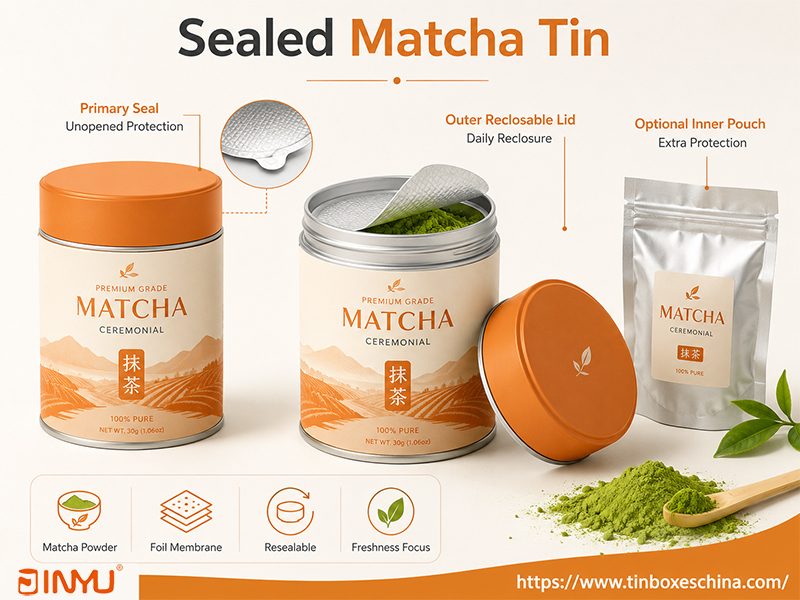
Matcha has unique packaging requirements. The fine powder has a very large exposed surface area and is extremely sensitive to storage conditions.
A commercial matcha tin might use:
A heat-sealed foil membrane
A metal easy-open end
A removable primary seal
A sealed inner bag
A separate outer resealable cover
The primary seal protects the unopened product. Once the customer removes it, the outer lid takes over daily reclosure. This distinction matters. A matcha tin can provide excellent barrier performance when unopened, but only moderate performance after the membrane is removed.
What we ask buyers to confirm:
Shelf life requirements for the unopened product
Filling and sealing equipment compatibility
Whether powder will accumulate on the rim and affect reclosure
Expected servings per day and duration of use after opening
For some projects, it is more practical to use a decorative tin with a sealed foil pouch inside than to set up a can-seaming line.
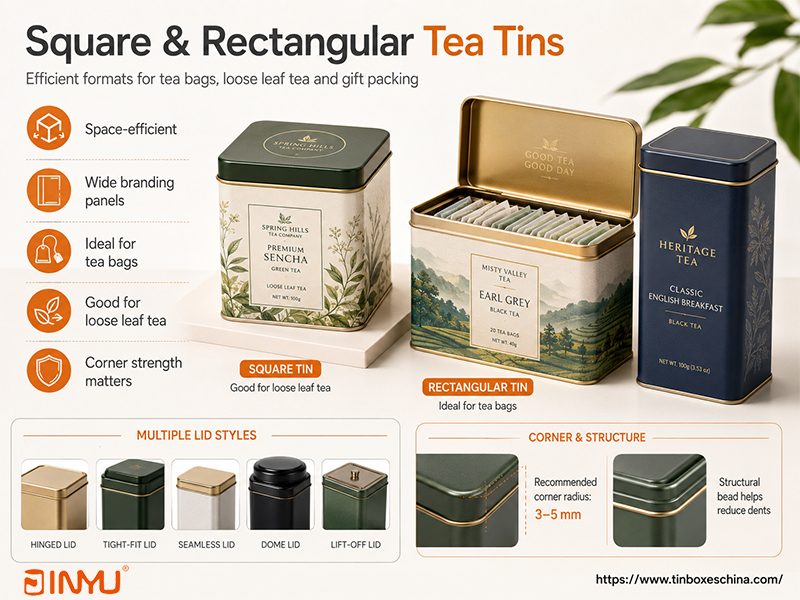
Square and rectangular tins are shape categories, not sealing systems. They can accept plug lids, double lids, hinged lids, or slip-on lids.
The main commercial advantage is efficient use of space. Straight-sided tins pack snugly into shipping cartons, retail shelves, gift boxes, and tabletop displays. The wide flat panels also provide generous room for logos, ingredient information, flavor systems, and brand storytelling.
Rectangular tins are especially good for tea bags — they can be made to internal dimensions that fit rows of sachets precisely. Square tins work well for premium loose leaf tea and coordinated flavor collections.
What we check most carefully in production: corners
In our forming workshop, corners are where we spend the most quality-control time on rectangular tins. Large flat panels with sharp corners show dents or distortion more easily than small cylindrical tins. We recommend a minimum corner radius of 3 mm for tins using 0.23 mm tinplate. For a recent tea bag tin project (200 × 120 × 45 mm), we increased the corner radius from 3 mm to 5 mm and added a subtle structural bead around the body. The dent rate during bulk shipping dropped from roughly 3 percent to under 0.5 percent.
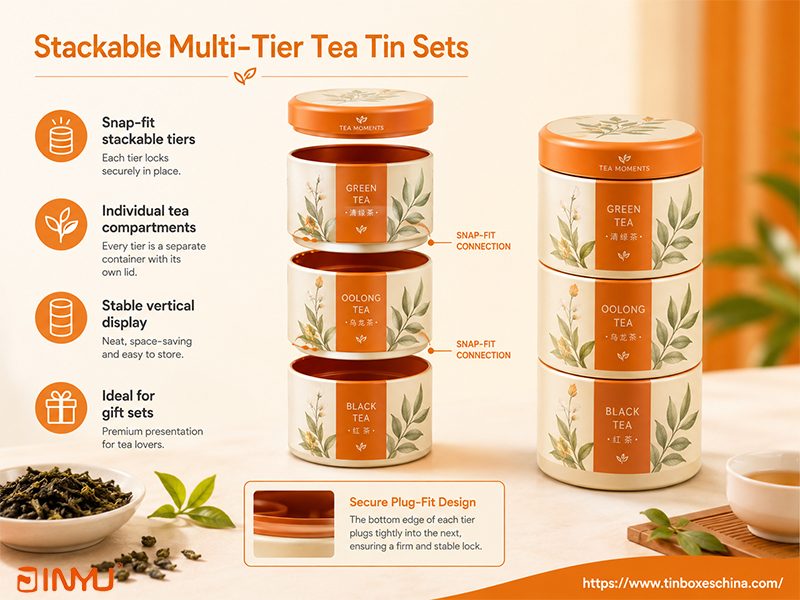
A stackable set is a collection of two or more separate containers that attach vertically. The bottom of one compartment fits into the lid or rim of the compartment below.
Each layer can hold a different tea, making this format ideal for:
Three-flavor gift sets
Tea tasting collections
Travel variety packs
Seasonal gift items
Retail discovery sets
Our fit-and-stability checks:
A good stackable design must be stable when assembled but not impossible to take apart. Even a 0.3 mm deviation in lid diameter between tiers can cause wobbling or difficulty separating the tins. We run a fit test on every batch: stack three tins, tilt the stack 15 degrees, and confirm they remain stable without binding.
Each compartment must have its own effective closure so that aromas don't mix between teas. Don't treat a three-tier set as one shared storage chamber. Total assembled height, center of gravity, and gift carton dimensions should also be confirmed before finalizing the structure.
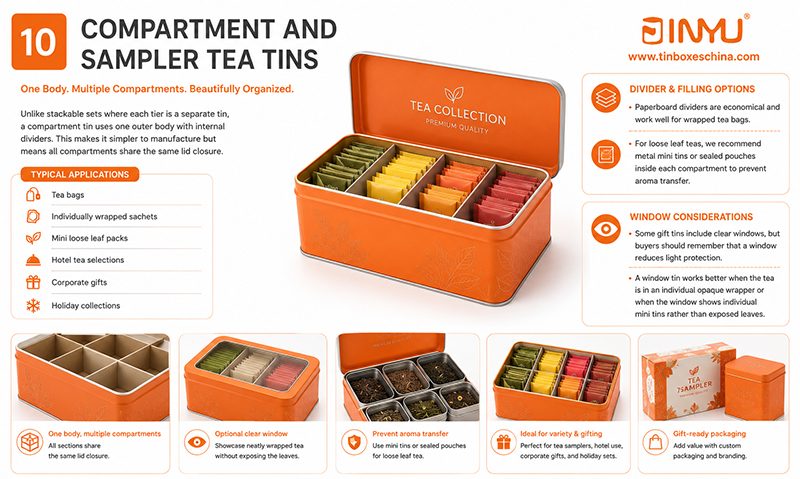
Unlike stackable sets where each tier is a separate tin, a compartment tin uses one outer body with internal dividers. This makes it simpler to manufacture but means all compartments share the same lid closure.
Typical applications:
Tea bags
Individually wrapped sachets
Mini loose leaf packs
Hotel tea selections
Corporate gifts
Holiday collections
Paperboard dividers are economical and work well for wrapped tea bags. For loose leaf teas, we recommend metal mini tins or sealed pouches inside each compartment to prevent aroma transfer.
Some gift tins include clear windows, but buyers should remember that a window reduces light protection. A window tin works better when the tea is in an individual opaque wrapper or when the window shows individual mini tins rather than exposed leaves.
| Tea format | Recommended starting structure | Critical buyer check | Common mistake |
| Premium loose leaf tea | Double lid or gasket-sealed canister | Lid fit, aroma protection, filled volume | Assuming every double lid is automatically airtight |
| Everyday loose leaf tea | Plug lid or slip lid with inner pouch | Opening width, refill convenience | Selecting size only from stated gram weight |
| Individually wrapped tea bags | Hinged rectangular or slip-lid tin | Internal row layout, sachet dimensions | Paying for a complex seal the product doesn't need |
| Matcha powder | Sealed matcha tin or screw-top with primary barrier | Unopened seal and after-opening reclosure | Treating the decorative lid as the only barrier |
| Multi-flavor gift set | Stackable tins or compartment box | Flavor separation, gift-box dimensions | Allowing aromatic teas to share one unsealed compartment |
| Bulk or refill tea | Wide-mouth tin with liner or sealed refill bag | Filled weight, handling strength, scoop access | Choosing a very deep tin that is difficult to empty |
One of the most important sourcing decisions is whether the tea will be in direct contact with the metal interior or enclosed in a primary pouch.
The tin provides light shielding, structural strength, a printable surface, gift appeal, and potential for reuse. The primary barrier — the component that actually protects freshness — can be a sealed foil or multilayer bag inside. This arrangement is often practical for export projects, since the tea can be filled and sealed on an existing flexible-packaging line.
If you are considering direct filling into the tin, the internal coating, hygiene process, tea formulation, destination market requirements, and shelf life expectations must all be assessed for the specific project. Packaging intended for food contact must meet the regulations of the destination market. In the European Union, food-contact materials must comply with Regulation (EC) No 1935/2004 and applicable good manufacturing practice requirements. We always recommend requesting documentation relevant to the actual material, coating, ink, intended food, and conditions of use — not relying solely on a generic "food-grade" statement.
A tea tin can have enough total volume but still be inconvenient to use if the opening is too small.
A small opening can make it harder to:
Fill with long-leaf tea
Place a sealed bag inside
Remove tea comfortably
Clean or inspect the interior
Load tea bags efficiently
For bulky loose leaf tea, we recommend an opening diameter of at least 60 percent of the body diameter for comfortable scooping. For automated or semi-automated filling, wider openings are almost always preferred. Smaller openings may be acceptable for powders or compact tea bags. The opening size, lid depth, and any inner-lid handle should be evaluated together — not as separate decisions.
Once the original tea is finished, tinplate tea packaging can be reused by customers for tea, coffee, spices, or household items. Steel is also a widely recyclable material and part of circular material systems. However, recyclability claims should be based on the actual collection and recycling infrastructure in the destination market, not on the assumption that every package will automatically be recycled.
For brands seeking a more credible sustainability message, we suggest focusing on:
Durable, reusable structure
Reducing unnecessary secondary gift boxes
Refill programs
Efficient square carton packing to reduce shipping volume
Designs customers are likely to keep
Simple, clear recycling instructions printed on the tin or label
For a double-lid tin or gasket-sealed canister, a premium loose leaf tea is a great place to start. A plug-lid or slip-lid tin is also fine if the tea is packed in a sealed pouch.
Not by default. Two lids can reduce exposure and improve closure performance, but airtightness depends on the whole structure, dimensional tolerance, seams and testing.
No shape is better than the other. Square tins are more efficient in the use of shelf and carton space, but round tins give a more traditional look and can be easier to form consistently. The kind of lid is more important for freshness than the shape of the body alone.
A rectangular tin with a hinge is handy for taking out tea bags over and over. A simple slip-lid box will suffice, especially if each tea bag is individually wrapped.
Often matcha packaging will have a primary membrane, easy open end or sealed inner pouch. This protects the unsealed powder. The outer lid allows reclosure after the primary seal has been removed.
There is no standard size for 100 grams. The volume of tea varies with the shape and density of the leaf, the processing and ingredients added. The tin suggested should be tested with the real tea.
When the material, the interior coating, the hygiene process and the food-contact requirements match. Instead, many brands use a sealed inner bag as their primary packaging.
One window lets in a little light on part of the product area. Better for individually wrapped tea bags, inner pouches or gift sets where the loose leaves are not displayed directly.
A standard slip-lid or plug-lid tin made to an existing mould is usually more economical than a double-lid, clasp, threaded or custom-tooled structure. The final cost will also depend on size, printing, embossing and packing.
There is no one best tea tin structure for all products.
Maybe a double lid is called for with premium loose leaf tea. A hinged box might be more practical for tea-bags. Matcha needs attention to the primary seal, while a multi-flavour gift collection requires effective separation between products.
The right purchasing decision starts with the tea format, filled volume, needed barrier and customer opening experience. Once the functional requirements are established, then the shape, printing and decorative finishes should be selected.
Jinyu supports custom tea tin projects, including existing mould choice, size testing, tinplate printing, lid development, embossing, sampling, production and export packing.
Email your tea type, fill weight, inner bag size, structure preference, order quantity and artwork idea to match up suitable tea tin options for your retail or gift programme.
1. Lv, H., Feng, X., Song, H., Ma, S., Hao, Z., Hu, H., Yang, Y., Pan, Y., Zhou, S., Fan, F., Gong, S., Chu, Q., & Chen, P. (2023). Tea storage: A not thoroughly recognized and precisely designed process. Trends in Food Science & Technology, 140, 104172. https://doi.org/10.1016/j.tifs.2023.104172
2. Fan, F., Wang, Z., Chen, X., Yu, Q., Yang, X., Su, X., Zhang, X., Wang, J., Xu, Y., Chen, P., Chu, Q., Guo, H., & Gong, S. (2024). Impact of oxygen scavenger, temperature, and packaging materials on freshness quality of packaged green teas during storage. Food Frontiers, 5, 2275–2289. https://doi.org/10.1002/fft2.423
3. Springett, M. B., Williams, B. M., & Barnes, R. J. (1994). The effect of packaging conditions and storage time on the volatile composition of Assam black tea leaf. Food Chemistry, 49(4), 393–398. https://doi.org/10.1016/0308-8146(94)90010-8
4. Kim, J. M., Lee, K.-Y., Choi, S.-G., & Heo, H. J. (2026). Effect of water activity and light exposure on the stability of bioactive compounds in matcha (Camellia sinensis) powder during storage periods. Food Chemistry, 510, 148655. https://doi.org/10.1016/j.foodchem.2026.148655
5. Bai, F., Chen, G., Liu, Y., Liao, Z., Jiang, Z., Hu, Y., Hou, R., Li, H., Peng, C., Wan, X., & Cai, H. (2025). Tea storage process: Flavor scalping in green tea caused by plastic packaging materials. Food Packaging and Shelf Life, 48, 101451. https://doi.org/10.1016/j.fpsl.2025.101451
6. Fukatsu, S., & Hara, T. (1971). Examination of bulk density measurement of refined green tea. Tea Research Journal, 34, 37–40. https://doi.org/10.5979/cha.1971.37
7. Marsh, K., & Bugusu, B. (2007). Food packaging—Roles, materials, and environmental issues. Journal of Food Science, 72(3), R39–R55. https://doi.org/10.1111/j.1750-3841.2007.00301.x
8. Broadbent, C. (2016). Steel’s recyclability: Demonstrating the benefits of recycling steel to achieve a circular economy. The International Journal of Life Cycle Assessment, 21, 1658–1665. https://doi.org/10.1007/s11367-016-1081-1
Obtenez les dernières informations et offres spéciales


 Réseau IPv6 pris en charge
 Français
 English
 Deutsch
 Español
 Português