
When people talk about airtight tea tins, they often mean very different things.
Some tea tins simply have a fitted lid and a metal body. Some offer stronger reclosure performance with a plug lid or double lid. Some rely on a gasket, foil seal, or inner bag to achieve better freshness protection. That is why the real question is not just whether a tea tin is “airtight,” but how airtight tea tins really work in actual tea packaging use.
For tea brands, loose leaf tea sellers, and packaging buyers, this distinction matters. A tea tin that looks sealed may be perfectly suitable for everyday storage, but not necessarily strong enough for longer shelf life, export shipping, humid markets, or highly aroma-sensitive tea products.
This article explains how tea tin packaging for freshness really works, what a standard tea tin can and cannot do, and how to choose the right sealing level for different tea products.
Tea is sensitive to its storage environment. Oxygen, moisture, light, foreign odors, and repeated opening can all gradually affect aroma, flavor, and overall quality.
This is one reason why tea tins for loose leaf tea are widely used. A metal body helps block light, protects tea during handling, and gives the product a more stable outer package than an opened pouch alone. But the body of the tin is only one part of the protection system.
In practice, tea freshness depends on several factors working together:
So if you want to understand how airtight tea tins really work, you need to look beyond the word “metal” and focus on seal design and real packaging conditions.
The honest answer is: not all tea tins offer the same sealing performance.
A standard slip-lid tea tin can provide good protection for many everyday tea applications. It helps reduce outside exposure, keeps out direct light, and supports a cleaner storage environment. For many black tea, herbal tea, and short-cycle packaging projects, that may be completely acceptable.
But from a packaging standpoint, a standard tea tin is not always the same as a fully high-barrier or hermetic pack.
That is where confusion often starts.
A tea tin may feel tight when closed, but still allow gradual air exchange over time. It may work well for daily consumer use, but not be ideal as the only freshness barrier for premium green tea or matcha. It may perform well when newly packed, but less strongly after repeated opening and closing.
So instead of asking only, “Are tea tins airtight?”, a better question is:
What sealing structure does the tea tin use, and is that level of protection suitable for the actual tea product?
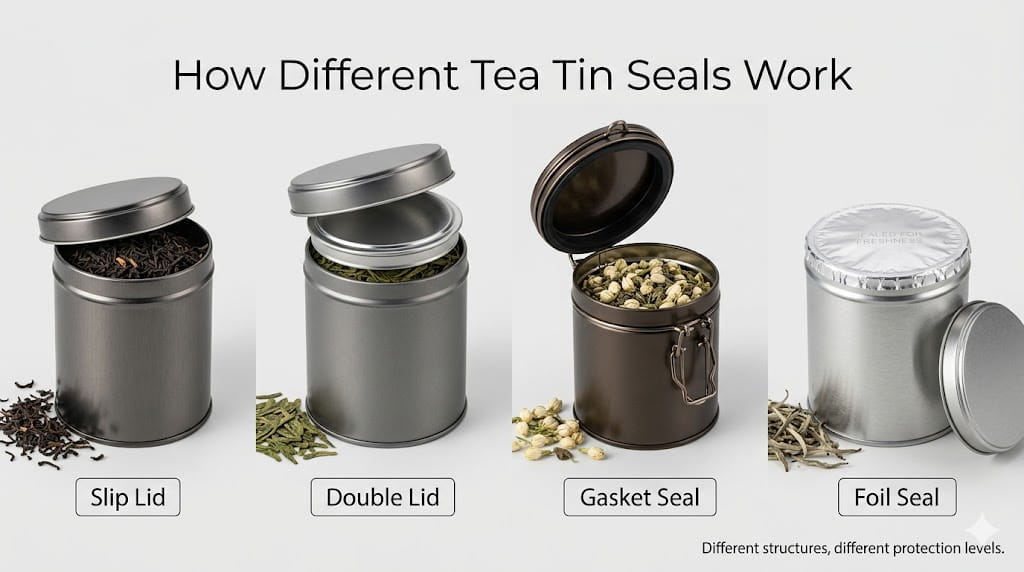
Not all sealed tea tins work in the same way. Different structures provide different levels of protection, convenience, and cost balance.
| Tea Tin Seal Type | How It Works | Protection Level | Best For | Limitation |
| Standard Slip Lid | Lid closes by friction fit between lid and body | Basic to Moderate | Everyday loose leaf tea storage, outer packaging with inner bag | Not a true high-barrier seal on its own |
| Plug Lid / Double Lid | Inner lid or secondary lid improves contact fit and reduces the air path | Moderate | Premium loose leaf tea, gift tea tins, better reclosure use | Better than a standard lid, but still not always enough for long shelf life alone |
| Gasket-Sealed Lid | A soft sealing element helps reduce gaps between lid and body | Moderate to High | Tea products needing better daily protection, reusable tea storage tins | Higher structure complexity and cost |
| Foil Seal / Induction Seal | Inner foil layer creates a stronger first-open barrier under the lid | High | Matcha, green tea, export packaging, longer shelf-life projects | Usually works as part of a full packaging system, not just lid design |
This is one of the most common tea tin constructions. It closes by pressure and friction between the lid and body.
What it does well:
Its limitation is that it is usually protective, but not necessarily fully airtight in a strict barrier sense. In many projects, it works best when paired with an inner bag.
A plug lid or double lid tea tin adds another layer of closure. In some designs, an inner lid fits more deeply into the opening. In others, an inner functional lid works with an outer decorative lid.
What it does well:
This type is often a better option for premium loose leaf tea and gift-oriented packaging.
Some airtight tea tins use a gasket or similar soft sealing element between the lid and body.
What it does well:
This type is often suitable when the tin is expected to function as a long-term reusable tea storage container after purchase.
In some tea packaging projects, the decorative lid is not the main freshness barrier at all. The true barrier comes from a foil layer or induction seal under the lid.
What it does well:
This is especially relevant when the tea product is sensitive, finely processed, or sold into conditions where a standard reclosable lid alone may not be enough.
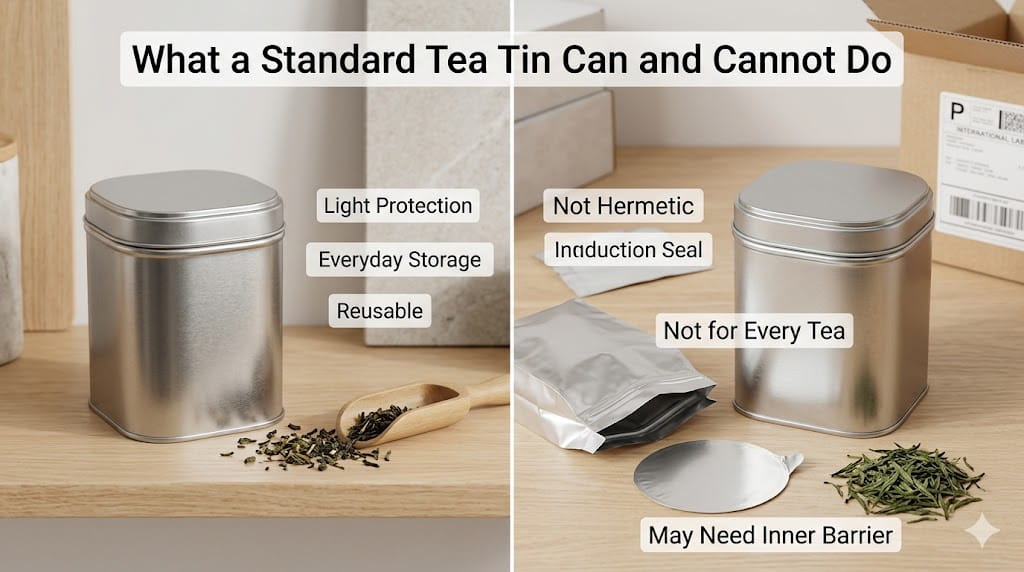
Many articles oversimplify this point. A standard tea tin is useful, but it is important to describe its role accurately.
| What a Standard Tea Tin Can Do | What a Standard Tea Tin Cannot Always Do |
| Block direct light | Provide a true hermetic seal by itself |
| Reduce casual outside air exposure | Fully replace an inner barrier for sensitive teas |
| Improve shelf appearance and packaging presentation | Maintain the same protection level after repeated opening |
| Support everyday storage and reuse | Guarantee long-term freshness for all tea categories |
| Work well as an outer package | Solve humidity-sensitive or export shelf-life needs alone |
This distinction is especially important for B2B buyers. If the product is intended for retail display, international shipment, humid regions, or premium positioning, the question is not simply whether to use a tea tin. The real question is:
What sealing system should this tea tin packaging use?
Even when a lid fits well, the empty air inside the tin still matters.
If a tea tin is too large for the actual fill weight, more oxygen remains inside the package from the start. After the first opening, that air space becomes even more important. Each time the tin is opened and closed, the tea is exposed again.
That is why a well-designed loose leaf tea storage tin is not only about shape or appearance. It should also match:
In other words, airtight tea tins work better when the structure matches the real filling condition.
Not every tea product should depend on the tea tin alone as the main freshness barrier.
In many commercial projects, the most effective solution is a packaging system, not a single component. That system may include:
This is especially relevant for tea products that are:
A decorative outer tin may be enough for some black tea sachets, while fine matcha or premium green tea may need a much stronger internal barrier.
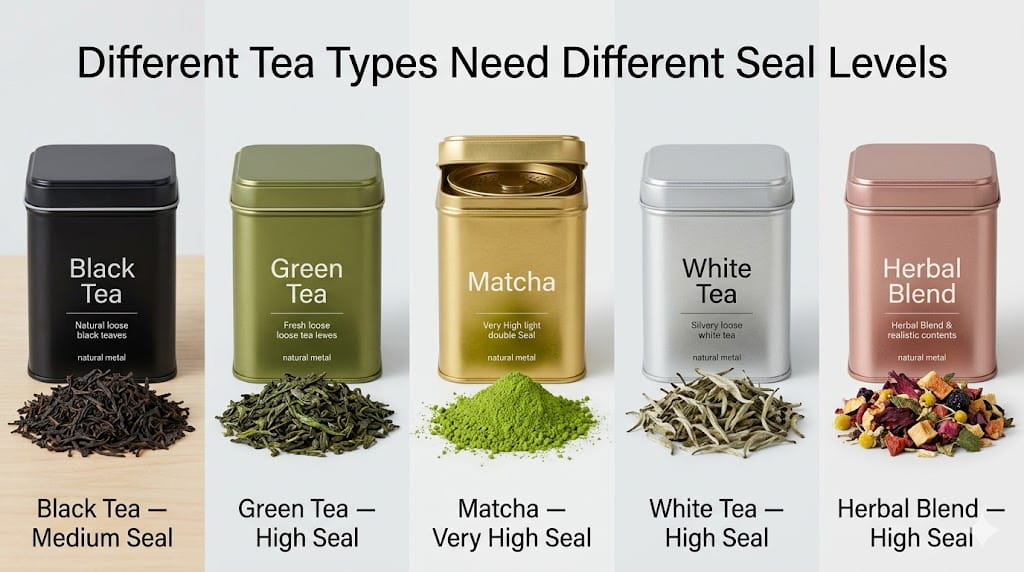
For buyers sourcing custom tea tin packaging, understanding product sensitivity is often the first step in choosing the right seal structure. Different tea categories do not all require the same packaging level, which is why seal design should be matched to the actual tea product rather than treated as a one-size-fits-all decision.
| Tea Type | Sensitivity Level | Main Risk | Recommended Packaging Approach |
| Black Tea | Medium | Gradual aroma loss over time | Standard tea tin with good lid fit, or tin with inner bag |
| Green Tea | High | Oxidation, moisture, flavor loss | Better-sealed tea tin, often with inner bag or foil seal |
| Matcha | Very High | Oxidation, moisture, rapid freshness loss | Tight seal structure plus inner liner or foil sealing |
| White Tea | High | Aroma change, moisture exposure | Better-sealed tea tin or protective inner packaging |
| Flavored Tea / Herbal Blends | High | Aroma loss and odor absorption | Tea tin with improved seal, often with inner bag for better aroma retention |
This table also shows why green tea storage tins and matcha tea tins are often discussed differently from standard black tea packs. They usually need a higher seal level, not just a nicer-looking container.
One common mistake is treating daily storage and retail packaging as if they were the same thing.
They are not.
After the product is opened, the tea tin should be easy to use, easy to reclose, and reasonably protective in normal home conditions.
Before first opening, the priorities are different:
A tea tin that works well on the kitchen shelf may not be strong enough as the only retail barrier pack. That is why tea tin packaging for freshness should always be judged by the full supply chain, not only by how the empty tin feels in hand.
If you are sourcing custom tea tins for a tea brand or private label tea project, a practical way to evaluate the packaging is to ask these questions:
Black tea may tolerate a simpler closure. Matcha, green tea, and aromatic blends may need better sealing support.
If an inner bag or foil layer provides the true freshness barrier, the tin may focus more on structure, branding, and protection.
A short local sales cycle and a longer export project should not use the same assumption.
Repeated use makes reclosure performance more important.
Humidity, transport stress, and storage environment all affect the required seal level.
These questions help turn a vague requirement like “airtight tea tins” into an actual custom tea tin packaging solution.
Some tea tins provide stronger sealing performance than others, but not every tea tin is completely airtight in a strict packaging sense. Performance depends on lid structure, fit, gasket use, inner seal design, and actual use conditions.
In many cases, yes. A double lid or plug lid usually improves closure quality and aroma protection, especially for premium loose leaf tea and repeated-use storage.
Sometimes yes. For products needing better freshness protection, longer shelf life, or stronger aroma retention, an inner bag or foil seal is often a practical choice.
They can be, but the answer depends on the tea type and seal design. Some teas can store well in a standard tea tin, while others need a stronger barrier system.
Green tea, matcha, white tea, and strongly aromatic flavored or herbal blends often benefit from better sealing support than more stable tea t
ypes.
The most useful way to understand how airtight tea tins really work is this:
A tea tin is not automatically airtight just because it is metal.
What really protects tea freshness is the combination of:
Some tea tins are perfectly suitable for daily storage. Some perform better as premium reusable containers. Some need inner bags, foil seals, or stronger lid engineering to support real shelf-life expectations.
For tea brands and tea packaging buyers, the goal is not to rely on a packaging buzzword. The goal is to choose the right sealing level for the real tea product, real market, and real storage conditions.
When that match is correct, airtight tea tins do more than look premium. They help tea stay fresher, store better, and perform more reliably from filling line to final cup.
For tea brands and buyers developing custom tea tins, the key is not to ask whether a tea tin is simply “airtight,” but whether the seal level matches the real product and market conditions.
If your project involves loose leaf tea, matcha, flavored tea, or export-oriented tea packaging, it is often worth evaluating the lid structure, inner packaging option, and required freshness level together at the beginning of the packaging process.
A better packaging decision starts with the right technical question — and that usually leads to a more reliable custom tea tin packaging solution.

Obtenez les dernières informations et offres spéciales


 Réseau IPv6 pris en charge
 Français
 English
 Deutsch
 Español
 Português