
Last year, a client sent us photos from Rotterdam. Their cookie tins had left our factory in perfect condition — every one had passed final inspection. By the time the container was opened at the destination, roughly 30% of the tins on the bottom pallet showed dented corners. No cracking. No carton collapse. Just dents. The client rejected the shipment.
A different client had the opposite problem. Their tins arrived at a UK distribution centre looking flawless. But when the end customer opened the first tin, half the cookies in the top layer were cracked. The tin itself was undamaged.
These two stories explain why this guide exists. Dented tins and broken cookies are different failures with different causes — and preventing them requires looking at the entire packed system, not just one component.
This is what we've learned at Jinyu from testing complete packed cartons before bulk shipment, and from investigating what went wrong when clients skipped that step.
Cookie protection usually depends on three things:
Controlling sideways movement so cookies don't strike each other or the tin wall
Limiting vertical movement without crushing the product
Reducing the effect of repeated vibration over hours of transit
Tin protection depends on a different set of factors:
Suitable tinplate thickness matched to the structure
Correct lid fit that holds under compression
Separation between tins inside the master carton
A properly specified carton that doesn't collapse or transfer pressure
Stable palletisation so the load doesn't shift
The damage pattern usually tells you where to look first.
| Damage found after shipping | First area to inspect |
| Dented corners | Carton corner strength, pallet edges, loading pattern |
| Broad dents on flat side panels | Carton fit, internal voids, stacking load |
| Scuffed lids or scratched printing | Tin-to-tin contact, missing individual wrapping |
| Chipped cookie edges | Sideways movement inside the insert |
| Cracked cookies in the top layer | Vertical headspace, missing or compressed top pad |
| Crumbs throughout the tin | Vibration, internal rubbing, loose arrangement |
| Lid partly released | Closure tolerance, internal pressure, carton compression |
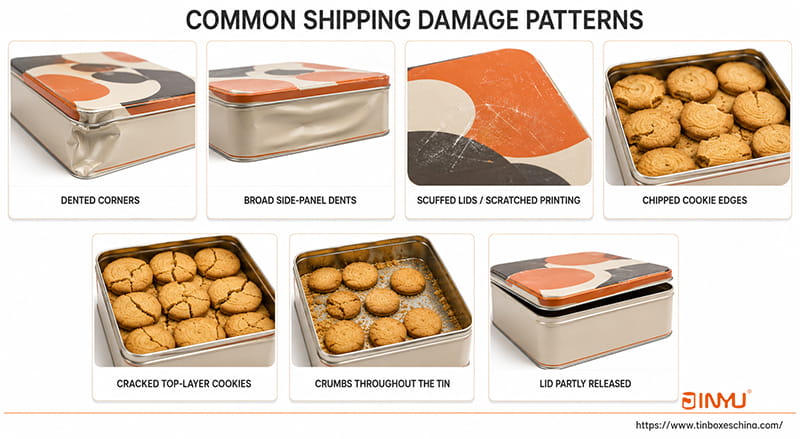
We look at this table as a starting point, not a conclusion. The pattern should be checked across several cartons before changing anything.
Final inspection at the factory only confirms the tins left in good condition. It says nothing about what happens afterwards.
A typical export shipment passes through road transport to port, terminal handling, container loading, sea transit, unloading, customs inspection, warehouse stacking, and final delivery. Each stage introduces its own combination of compression, vibration, impact, and humidity.
What we've learned: The bottom tier of a pallet carries the full weight of everything above it. If the cartons aren't engineered for that load, the tins inside will absorb the pressure. Pallet edges are another high-risk zone — a forklift tyre brushing against the corner of a pallet transfers force directly into the cartons and tins at that point.
Before changing the tin or carton, note where the damage appears:
Is it concentrated in the bottom tier?
Does it cluster around pallet edges?
Are the dents on the same face of multiple tins?
Do cookies break inside tins that remain externally perfect?
Are affected cartons near the container doors?
Repeated patterns tell you more than one isolated damaged tin.
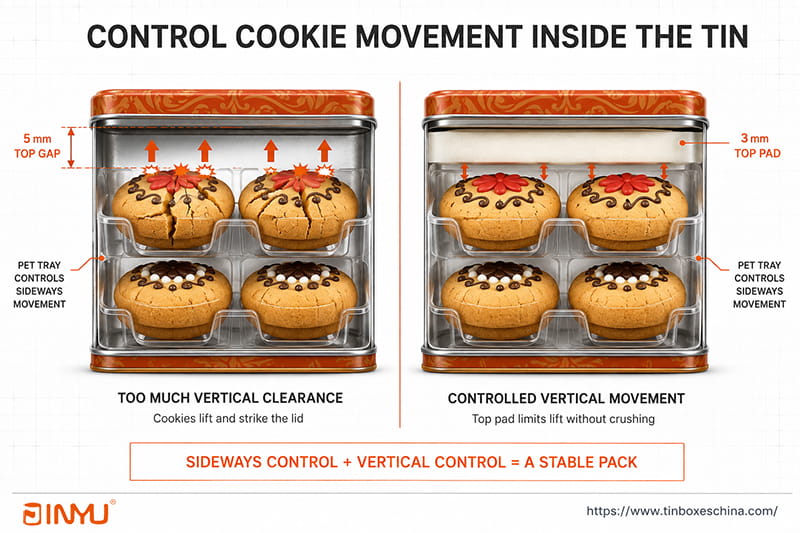
When cookies break inside an undamaged tin, the internal pack is the problem — not the tin.
A project we reviewed last year illustrates this well. The client packed 12 decorated cookies in a square gift tin with a PET tray. After a vibration test, the upper layer showed cracks. The initial assumption was that the tin needed thicker material. It didn't. The tray cavities controlled sideways movement perfectly. The problem was a 5 mm gap above the top layer — enough for the cookies to lift and strike the lid repeatedly during vibration. A 3 mm top pad solved it. No tin change needed.
Sideways movement: If cookies can slide, they will strike each other, rub against dividers, or hit the tin wall. Depending on the product, control this with PET trays, close-fitting dividers, paper cups combined with pads, or individual flow wrap.
Vertical movement: Top clearance is just as important. Too much space lets the top layer lift and strike the lid. Too little means the lid presses directly on the cookies when cartons are stacked. A top pad helps, but its compression behaviour must be checked with the real product. We've seen clients use corrugated board as a top pad, only to find it compresses by half its thickness under stacking load — leaving the same gap it was meant to fill.
Always confirm clearance using the final cookie count, actual insert, sealed bag, folded seals, and all layer pads. An empty tin tells you nothing useful.
Tinplate thickness matters, but it's only part of the story.
Common options at Jinyu include 0.23 mm, 0.25 mm, and 0.28 mm. For many standard cookie tins, 0.23 mm works fine. For larger rectangular tins with broad flat panels — anything above about 150 mm on the long side — we often recommend 0.25 mm as a starting point. Going thicker without addressing geometry usually adds cost without solving the problem.
Structural features can improve rigidity without increasing material everywhere. Rolled edges, body beads, steps, and carefully designed corner radii all contribute. We've had a rectangular tin with a 3 mm corner radius dent consistently at the corners during carton compression testing. Increasing the radius to 5 mm, using the same tinplate, eliminated the problem. The shape, not the material, was the weak point.
Lid fit also needs practical evaluation. Too loose, and lids shift or release under impact. Too tight, and the lid becomes difficult to open after the body has absorbed compression during transit. We test lid function on samples after they've been through the full shipping test — not just fresh off the line.
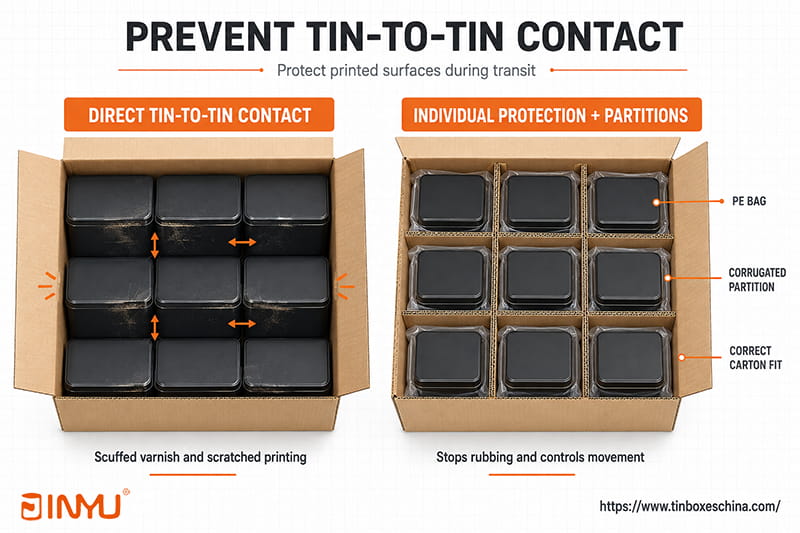
A tin can remain perfectly functional and still be rejected because the varnish is scuffed or the lid looks worn.
We had a project with matte black tins — one of the most unforgiving finishes for visible scratching. The first shipment went out with tins packed directly against each other. When the cartons were opened, the surfaces looked like they'd been handled for years. The fix was simple: individual PE bags plus corrugated partitions between tins. Added cost per tin was under two cents. Zero complaints since.
Protective options include individual PE bags, tissue sleeves, layer pads, corrugated partitions, and protective sheets between lids and bases. Pay extra attention to embossed lids, metallic finishes, and large areas of dark printing — abrasion shows most on these surfaces.
Carton fit is a balance. Too much internal space lets tins accelerate and collide during handling. Too tight means external compression transfers directly to the tin bodies. A bulging carton creates unstable pallet surfaces and concentrates pressure on the tins near the top.
The master carton is the tin's real transport vehicle. It should never be selected from whatever box happens to be close in size.
Relevant factors include carton internal dimensions, number and orientation of tins, total gross weight, single- or double-wall construction, edge crush resistance, use of partitions, expected pallet height, and warehouse stacking time.
We once loaded a container with 5-ply cartons on the bottom tier and 3-ply cartons above. By the time it reached Europe, the bottom tier showed visible compression. The cartons had absorbed the load, but not without deforming — and some of the tins inside showed side-panel dents. Now we standardise carton grade across each shipment and calculate stacking load from the bottom tier upward.
Don't judge cartons by ply count alone. A well-designed double-wall carton can outperform a poorly constructed triple-wall one. The carton supplier should evaluate the board specification using your final dimensions, gross weight, and stacking requirements — not a generic template.
Sea freight exposes cargo to substantial temperature and humidity swings. Two separate problems arise.
For the cookies: The primary moisture barrier is the sealed inner packaging, not the tin. Cookies must be at a stable temperature before sealing. We investigated a shipment where cookies arrived with softened edges. The cause? They were packed at roughly 35°C, still warm from cooling, then sealed in high-barrier pouches and shipped through a tropical port. The residual heat created condensation inside the sealed pack. Extending cooling time until the cookies were below 25°C at filling solved it completely.
For the carton: Corrugated board absorbs moisture and loses stacking strength. A carton that holds up in dry conditions may collapse slowly during weeks at sea. Check that the container is dry and leak-free before loading, avoid visibly damp pallets or cartons, and consider pallet top covers for routes with high humidity exposure.
Desiccants should not be added casually inside food packaging. Their suitability, capacity, placement, and food-contact compliance must be evaluated for the specific application. We have never added a desiccant to a cookie tin without first confirming these details with the client.
A strong tin and a well-fitted carton still fail if the pallet load is unstable.
Before shipment, check:
Cartons do not overhang the pallet edge
The pallet deck is level and undamaged
No nails or broken boards contact the cartons
Carton corners remain vertically supported
The stacking pattern distributes weight consistently
Corner boards are used where handling is rough
Stretch wrap controls movement without crushing cartons
Straps do not create concentrated pressure on upper tins
Stretch film should stabilise the load, not reshape it. We've seen pallets wrapped so tightly that the cartons deformed before the container was even loaded. Increasing film tension is not a substitute for a stable carton pattern.
Container gaps matter too. If pallets or floor-loaded cartons can move during braking or handling, even strong cartons will suffer. Use appropriate blocking or restraint for the actual loading method.
When damage concentrates on pallet edges, lower tiers, or one side of the container, investigate the unit load before redesigning the retail tin.
There is no single test programme for every exported cookie tin. A pallet shipped directly to a distributor faces different risks from an individual tin sent through a parcel network.
At Jinyu, we ask clients one question before designing a test plan: How will this pack reach the end customer?
Parcel or e-commerce delivery → individual package testing
Mixed freight or LTL → carton-level testing with compression
Full pallet or direct import → unit-load testing including stacking simulation
Multiple stages → a sequence that reflects the journey
For clients shipping into Amazon FBA or parcel networks, we usually recommend ISTA 3A. For palletised sea freight, ISTA 3E or ASTM D4169 with a distribution sequence is more relevant. We don't expect the buyer to know these standards — we ask for the destination and route, then suggest the appropriate procedure.
The important principle is that a single dramatic drop test tells you very little. Export damage usually results from accumulated events: hours of vibration, sustained compression, then a sharp impact during unloading. The test sequence should reflect that reality.
What we inspect after each test stage:
| Test stage | What it evaluates | What we check |
| Conditioning | Temperature and humidity effects | Carton condition, seals, material changes |
| Compression | Pallet stacking loads | Carton collapse, side-panel dents, lid deformation |
| Vibration | Repeated vehicle movement | Cookie crumbs, rubbing, insert displacement |
| Drop or impact | Handling accidents | Corner dents, cracked cookies, closure failure |
| Final examination | Complete pack performance | Retail presentation, function, acceptance criteria |
Acceptance criteria should be agreed before testing. For the tin, this includes maximum acceptable dent size, lid function, and print condition. For cookies, it covers broken pieces, edge chipping, crumb levels, and decoration damage. Without agreed criteria, the supplier and buyer will look at the same tested carton and reach different conclusions.
Several changes that sound sensible often fail in practice:
Thicker tinplate without checking cookie movement — the dents may reduce, but the cookies still break
More void fill — loose fill shifts during vibration and provides little control
A very thick top pad — excessive compression cracks fragile cookies before shipping begins
A "FRAGILE" label — labels do not replace structural protection
Testing empty tins — an empty tin cannot represent the mass and forces of the final pack
Running only a drop test — vibration and compression create different failures
Applying more stretch-wrap tension — this can increase carton and tin deformation
The fix that works is the one connected to the observed failure, not the one that simply adds the most material.
A request for "one printed cookie tin" does not contain enough information to design an export pack.
For a useful quotation and packaging review, provide:
Finished cookie dimensions and realistic tolerances
Weight and number of cookies per tin
Preferred arrangement and number of layers
Whether cookies are plain, filled, iced, or decorated
Required inner bag, tray, cups, or dividers
Preferred tin size, shape, and lid type
Quantity of tins per master carton
Destination country and port
Road, sea, air, pallet, or parcel delivery
Expected warehouse stacking conditions
Whether the shipment will be repacked after arrival
Required transport test procedure
Why this matters: When a client gives us their full distribution route, we can recommend tin structure, carton grade, and pallet configuration as one system. When they only ask for a unit price, those decisions are left to chance.
Confirm before approving bulk production:
Real production cookies have been measured
The largest realistic cookie fits the insert
Sideways and vertical movement are controlled
The top pad does not crush the product
The sealed inner bag fits inside the usable tin dimensions
Tinplate and structure match the packed load
Lid fit has been evaluated after packing
Printed surfaces are protected from rubbing
Carton dimensions and gross weight are final
Carton performance matches the stacking plan
There is no pallet overhang
Stretch wrap or straps do not deform the cartons
The container and moisture-control plan are suitable
The test procedure reflects the intended route
Tin and cookie acceptance criteria are documented
A final approved packed sample is retained
It can improve rigidity in some structures, but it is not a complete solution. Large unsupported panels, weak outer cartons, pallet overhang, and concentrated pressure can still cause dents. Thickness should be reviewed together with the tin geometry and complete shipping pack.
The cookies probably have too much room to move inside the tin. Repeated vibration makes them collide with each other, the insert, or the lid even when the outer tin remains undamaged. Check internal clearance first.
Some clearance is needed for production variation and safe lid closure, but excessive headspace allows vertical movement. We aim for 2–4 mm above the top layer, depending on cookie fragility and top pad compression. Confirm with real cookies and a transport test.
A formed PET tray usually provides more precise positioning. A paper divider can organise an assortment but allows more movement if cells are oversized. The choice depends on cookie fragility, presentation, packing speed, and budget.
Not by itself. A bag provides containment and barrier protection, but a loose bag rarely fixes each cookie in position. Fragile products still need a tray, divider, paper cups, or layer pads.
The answer depends on how the pack travels — parcel, mixed freight, full pallet, or a combination. Tell us the destination and route, and we'll suggest the appropriate procedure rather than applying one standard drop height to every shipment.
It varies by procedure, sample quantity, and what you need documented. For most cookie tin projects, a complete test sequence costs far less than one rejected shipment. We can advise on the most practical option based on your route.
Potentially, yes. Changing carton dimensions, board, supplier, quantity per carton, or pallet layout alters the shipping system and may change compression, vibration, and impact performance.
It can contribute to both. Moisture reduces corrugated-carton stacking strength, while inadequate cooling or barrier packaging affects cookie texture. The inner bag, carton, pallet, and container conditions should be evaluated separately.
No laboratory programme can reproduce every handling event. Testing reduces uncertainty and reveals likely weaknesses, but it should be combined with quality control, correct loading, and clearly defined acceptance criteria.
Preventing dented tins and broken cookies doesn't begin with a single material upgrade. It begins by identifying which part of the pack is failing.
If cookies are moving, improve internal positioning. If tins are rubbing, improve separation. If side panels are denting, examine carton support and load concentration. If damage appears in the bottom pallet tiers, review stacking before redesigning the retail tin.
The strongest result comes from evaluating the cookie, insert, tin, carton, and pallet together under conditions that reflect your actual route.
Tell us your cookie dimensions, piece count, preferred insert, target tin size, destination, and distribution channel. We'll review the complete pack against our existing library of over 3,000 tin moulds, recommend the right structure and carton configuration, and advise on appropriate transport testing. You'll receive a response within 48 hours.
Custom printed cookie tin projects generally start from 5,000 pieces per design and size. Sample development normally takes 7–10 days, with mass production typically completed in 25–35 days after sample approval.

Obtenez les dernières informations et offres spéciales


 Réseau IPv6 pris en charge
 Français
 English
 Deutsch
 Español
 Português